Exiles of colsec v1 0, p.1
Exiles of colsec (v1.0), page 1


08-04-2023
Exiled as criminals, five young rebels survived the crash of the Colonization Section spacecraft. Together they fought to make a new life on the harsh alien world of Klydor:
Samella—sold to ColSec by her own family; gifted with strange mental powers.
Heleth—raised in the Bunkers of Old London by a gang called the Vampires.
Jeko and Rontal—one Asian, one Black; both Free Streeters from the blasted city known as Limbo.
And Cord—the strong but quiet barbarian highlander who became their leader.
But one other had escaped and now threatened their survival: Lamprey—a brutal, half-crazed killer who wanted to rule them as slaves….
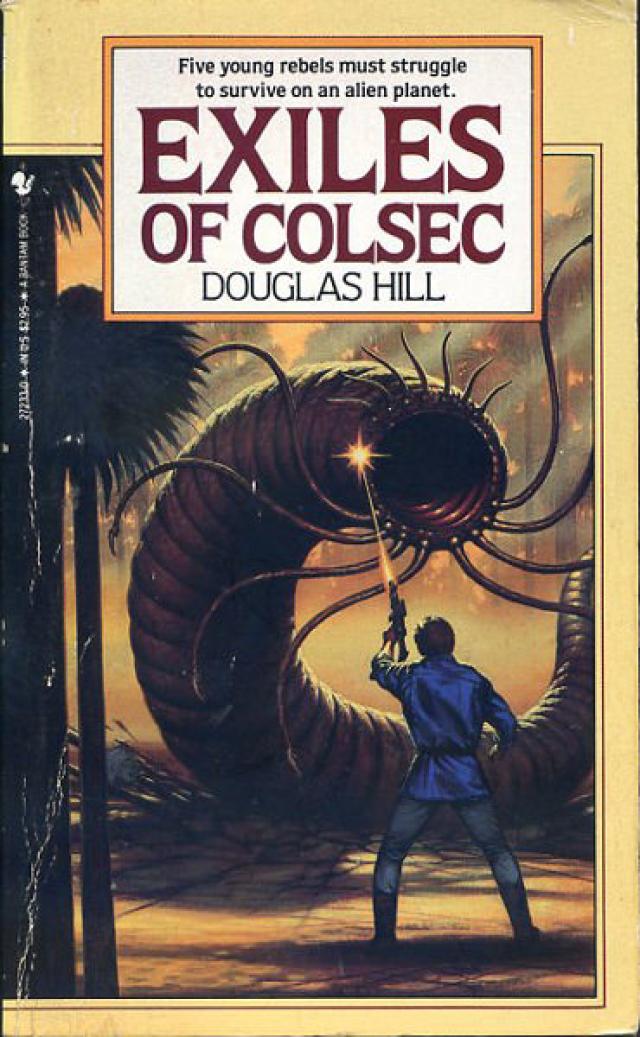
ALIEN PERIL
It reared up out of the turf, a living cylinder, thick and flexible like an oversized worm. Cord saw that it was covered with a thick segmented shell, like plates of armor. It was eyeless, with a spray of thin tendrils sprouting from the front of its head. And on the underside of the head was a wide gaping mouth, surrounded by long, sturdy tentacles, each with a sharp, barbed hook at the end.
The creature slid swiftly forward in an oozing slither, disturbingly silent. One of the tentacles around the repulsive mouth struck out like a snake. Lamprey raised the laser rifle and took aim. The beam struck dead center. But nothing happened.. ..
Bantam Books of Related Interest
Ask your bookseller for the titles you have missed
VERY FAR AWAY FROM ANYWHERE ELSE by Ursula LeGuin
INTERSTELLAR PIG by William Sleator
SINGULARITY by William Sleator
DEVIL ON MY BACK by Monica Hughes
DRAGON DRUMS by Anne McCaffrey
DRAGONSINGER by Anne McCaffrey
DRAGONSONG by Anne McCaffrey
FINGERS by William Sleator
THE BRONZE KING by Suzy McKee Chamas
Exiles of ColSec
DOUGLAS HILL
BANTAM BOOKS
TORONTO • NEW YORK • LONDON • SYDNEY • AUCKLAND
FOR J.G.
in rueful acknowledgment
of the First Law
RL 7, IL age 12 and up
exiles of colsec
A Bantam Spectra edition / June 1986
Bantam Starfire edition / January 1988
The Starfire logo is a registered trademark of Bantam Books, Inc. Registered in U.S. Patent and Trademark office and elsewhere.
All rights reserved.
Copyright © 1984 by Douglas Hill.
Cover art copyright © 1986 by David Mattingly.
No part of this book may be reproduced or transmitted
in any form or by any means, electronic or mechanical,
including photocopying, recording, or by any information
storage and retrieval system, without permission in
writing from the publisher.
For information address: Atheneum Publishers,
866 Third Avenue, New York, NY. 10022.
ISBN 0-553-27233-0
Published simultaneously in the United States and Canada
Bantam Books are published by Bantam Books, Inc. Its trademark,
consisting of the words “Bantam Books” and the portrayal of a
rooster, is Registered in U.S. Patent and Trademark Office and in
other countries. Marca Registrada. Bantam Books, Inc.,
866 Fifth Avenue, New York, New York 10103.
PRINTED IN THE UNITED STATES OF AMERICA
0 11 10 9 8 7 6 5 4 3 2
Contents
1 Dream and Nightmare
2The Choice
3 World of ColSec
4 Strangers
5 Responsibility
6 The Leader
7 Forest-dwellers
8 Alien Attack
9 Night Watch
10 Defeat
11 The Screaming
12 Moving On
13 Heart of the Forest
14 The Search
15 Massacre
16 Sacrifice
17 Klydoreans
About The Author
1 Dream and Nightmare
The broad chamber, with walls and low ceiling of blank, colourless metal, lay in shadow and silence. Only the muted glow from a computer screen, set into one wall of the area, interrupted the darkness. But nothing interrupted the stillness.
It was the empty, gloomy stillness of a long’ forgotten tomb. And it was made all the more tomb like by the twelve containers fastened solidly to the metal floor in the centre of the area.
In shape they were like caskets, or large coffins, made of sturdy condensed plastic. But inside, they were softly padded—the padding moulded to the individual shapes of the twelve bodies that lay with’ in. Youthful human bodies, as silent and still as everything else in the area, eyes closed, with no sign of heartbeat or breathing.
But in the sides of the containers, behind the padding, were complex devices that worked to nourish, to preserve and support life. Through the pad” ding a host of needles reached out to thrust deeply beneath the skin of the bodies. Other parts of the skin were covered with the electrodes of monitors and scanners. And so the bodies were healthy and alive.
Now and then a group of muscles might ripple and flex uncannily, but the movement was caused by a gentle shock from an electrode, to maintain muscle tone and fitness. The minds within the bodies felt no movement. The minds were in a sleep that went beyond sleep, a coma of life in suspension.
Yet within the deepest reaches of those minds, the dreams lived.
Stormy, chaotic dreams, most of them, of grim and ruined landscapes, of misery and hardship—but also of laughter and crashing music and wild, high-speed excitement. In two of the young minds, the dreams centred on a sprawling urban area of crumbling buildings and filthy, broken streets, an area that armed and armoured Civil Defenders entered only in hover-tanks. It was a place populated by human refuse—the thugs and the druggies, the twisted and the insane, the hopeless and the defeated. It was a place called Limbo.
But among the outcasts of that place roamed other groups—packs of young people, wearing strange garb, finding their excitement in acts of petty crime and violence: the free Streeters of Limbo, homeless but not helpless, defiantly rejecting the grey, dull, ordered world around them.
In another casket, a similar dream—of wild, violent, strangely decorated youths turning their backs on the regulated ordinary world. But this was a dream of chill and gloom and damp, in endless underground passages, called the Bunkers—rat-warrens beneath the ruins of a once-magnificent capital city.. There the youths made their free lawless domain, where even the most coldly determined squads of Civil Defenders could not pursue them.
But in a different casket, a different dream. Images tinged with melancholy beauty—of an unending sweep of dusty plain, of high hot summer skies, of the eye-searing winter sun on fresh snowfields. And mingled with these images, the memory of isolation, of bone-twisting cold, of the clench of hunger.
Oddly, in among the images that lived in that one dreamer, there came fragmented glimpses of other scenes. Wild pursuits through crumbling city streets, noisy charges through dark twisting tunnels. Scenes filled with the shadowy forms of young people, weirdly dressed, with strange distorted faces… .
Then again, another mind in another casket had its own individual dream. This one recalled a land of storm-clouded skies and lancing rain, of steep brush-covered mountain slopes and wide lakes of black and pitiless water. But to the dreamer it was a land of beauty and delight, made into a place of joy by the presence of a red-bearded giant wearing skins and furs and cloth with a colourful criss-cross pattern— the beloved uncle, who had raised the young dreamer in that wild land and taught him all its ways.
The dream recalled the breathless stalking of vast herds of red deer; the warmth of a small stone hut and a dancing fire that kept the icy wind at bay; occasional nights among other wild folk in skins and furs, the graceful leaping dances, the soul-saddening music, the drinking and tale-telling and competitive tests of strength. And the young dreamer relived his own part in those tests, when he was grown to a stocky bulk of solid muscle, and set a gleam of pride in the uncle’s eyes.
But then the dream shifted, from happiness to horror. The fall that had injured the uncle—and the young dreamer slinging the huge groaning body over his powerful shoulders and walking forty kilometres to the nearest civilized place of streets and houses, to seek help. Help that was refused, because the young one had none of the necessary stuff called money.
Then the death of the beloved uncle, in raging agony, and the red fury that bloomed within the young man, amid grief and loss and thunderous hate. That fury had set out to smash the clinic that had turned the dying uncle away—and it had needed half a dozen club-wielding Civil Defenders to subdue it.
The dream then remembered days of drugged mindlessness in a cage, the cloudy awareness of a five-minute trial, and the judgment: transportation, for life, to the prison colony of Antarctica, as befell all young offenders against the civil order.
So that dream came to its end, as it had many times before. But before it might begin again, as it also, had continuously done, like an endless loop of video tape, something wholly unusual stopped it.
Alone among all the sleepers in the twelve caskets,’ in that dim, metal-walled chamber, that dreamer awoke.
* * *
His body was filled with a vibrating throb of pain, and his mind was filled with nothingness. Empty’ eyed, he watched needles and electrodes slide back into the padded sides of the casket. Empty-eyed, he stared down at his body—the slightly freckled skin, the solidity of mounded muscle—and did not recognize it. Slowly he closed his eyes, as if seeking to return to the dream.
But his eyes jerked open again as another needle probed out from the padding, into his skin. The injection seemed to flow through his every cell, in a wave of cool soothingness. The pain receded—and with it went the clouds in his mind.
He remembered. He was Cord MaKiy, sixteen years old, and a Highlander, one of the wanderers of a harsh and beautiful land too bleak and poor and remote to interest the rulers of the rest of the world. And, he remembered, he was no longer in that land.
He clamped his eyes shut again, but tears seeped through his eyelids as the memories relentlessly formed. The beloved uncle was dead, the Highlands lost to him forever. And he, Cord MaKiy, was a criminal, condemned forever to the Antarctic prison.
But then his jaw tightened, and muscles leaped and bunched in his arms as he clenched his fists. If he was awake, he thought, they must be arriving. And he would not arrive tear-stained and whimpering like a child.
He opened his eyes once more, and felt a jolt of surprise. The top of the casket had raised itself, on silent hinges. He saw a blank dimness above him, a slightly curved ceiling of colourless metal. Slowly he sat up, shivering slightly in the thin, cool air. He was not aware that, until some moments before, there had been neither air nor warmth in that metal-walled chamber.
At his feet he saw a bundle of muddy-brown clothing—strange to him, though commonplace in the ordinary world. Plain tunic and trousers, sturdy boots. Automatically he pulled on the clothes, ran fingers through his tangle of auburn hair, then clambered from the casket. He realized that his body was moving normally, yet somehow he felt slow and weary, and wondered for a moment how long he had been unconscious in the casket.
And why, he asked himself, should they send us this way, to Antarctica? It can’t be that far… .
But he knew he was not familiar with many of the ways of the civilized world. So he let the question go, trying to ignore the twist of unease within him.
He stared around blankly at the other eleven caskets, closed and silent. Then his eye was caught by a sudden brightness across the area. Sharply defined golden letters had appeared on the screen of the computer.
He moved towards it. He had learned something of reading and writing from his uncle, but even so he read the letters slowly, with puzzlement.
THIS IS A GUIDANCE AND DATA STORAGE
COMPUTER SHUTTLE-FORM 181-QX9
VOICE PROJECTIVE AND VOICE ACTIVATED
SPEAK ALOUD TO BEGIN COMMUNICATION
Cord understood only a little of it, but grasped the idea that he should say something.
“Uh… what do I say?” He felt a little foolish, and his voice croaked from lack of use. But it did not seem to matter.
“Thank you for activating me.” The computer’s voice was soft and human, but totally without emo-tion. “I am known as GUIDE. I am here to provide information and to answer your questions.”
Cord blinked, unable to think for a moment. “Good,” he said at last. “You can… you can tell me if we’ve got to Antarctica, now.”
“Antarctica is on Earth,” the soft voice of GUIDE told him. “You are not on Earth.”
For all their quiet tone, the words struck Cord like hammers. His legs felt weak, his flesh cold, his mind reeling. It wasn’t true, he thought numbly. How could it be true? It was a lie—a joke—maybe a form of mind-bending torture, a cruel invention of the Civil Defenders.…
But the computer was going on, doing its duty, providing information.
“You and the others are inside an orbital shut-tie, which is being carried by a space freighter, en route to a Colonization Section base in the Procyon planets. The shuttle will be automatically released when the freighter passes near a planet named Klydor, after a flight of four months. We are now approaching Klydor, and have left translight and re-entered normal space. After release, the shuttle is programmed to land on Klydor, where you and the others will seek to establish a new human colony.”
Even in his daze, Cord understood much of that. Some kind of spaceship, carried by another spaceship, to be dropped off on some planet….
Disbelieving horror brought the sudden sourness of nausea into his mouth. It couldn’t be…. The frozen wastes of Antarctica would have been bad enough—but another planet? Earth some unimaginable, unbridgeable distance away, lost to him forever, as he was flung unconscious across space, to some unknown alien world…. Flung by ColSec….
Deep within him, behind the fear and horror and shock, a small red flame began to bum—a flame of wild, barbaric anger. The flame did not grow or spread, but it had been ignited, and it would not fade or die. It was bom of hatred—for ColSec, Colonization Section, one part of the vast organiza-tion that gripped the entire Earth in its demanding, oppressive control.
Trying to fight the numbing shock, Cord forced his mouth to form words. “When?” he croaked. “When do we get there?”
“That cannot be computed,” said the soft voice of GUIDE. “There is a malfunction. The shuttle is unable to disengage.”
For a moment Cord felt he would go insane. There was too much horror, there were too many sudden unbelievable facts that he barely understood, yet that filled him with raw and screaming fear. He stood rooted, covered in a sudden drenching sweat, trembling and unseeing. Yet, as if hypnotized, he heard every soft word as the computer went on.
“The humans in the shuttle have two alternative courses of action. I am not programmed to make human decisions. You have been awakened, to decide.”
2The Choice
Somehow the word “decide” rolled back some of the clouds of shock from Cord’s mind. Out of the depths of memory he heard his uncle’s deep voice, words that he had heard many times. “In this land we are our own masters, laddie,” the uncle would say. “We live as we will, walk where we please. We decide for ourselves.” The memory steadied Cord, and again he found his voice. “Why choose me?”
“The psychological profiles of all of you are in my data banks,” GUIDE told him. “Yours has the necessary qualities to make the decision.”
Cord took a deep breath. He was not sure what a psychological profile was, but he was unwilling to appear weak or afraid, even to a computer. “What is it, then? What must I decide?”
And in that soft unperturbed voice, the computer told him.
The shuttle-craft was attached to the outside of the freighter, to be automatically released at the right time. But the release mechanism had gone wrong, and the shuttle was unable to detach itself so that it could head for the planet Klydor. One course of action, then, would be for Cord and the others to remain where they were, and hope to cross the path of another human spacecraft, while the freighter went on towards its destination—which it would reach in a further six months.
But if they did not intersect with another ship, GUIDE said, then when the freighter finally reached its goal the young people would no longer be alive.
“The caskets were not designed for a voyage of such length,” GUIDE explained. “The nutrients and other elements that have kept you alive, for the past four months of suspended animation, have been nearly used up. And the shuttle’s power source could not take over the life support systems for that length of time.”
Cord shook his head numbly, again grasping only the general meaning. If they stayed where they were, in space, they would soon die.
“What’s the other choice?” he asked.
GUIDE told him. The simple controlling pro-gramme that kept the freighter on its course could be over-ridden, through a link-up with GUIDE. The entire freighter, with the shuttle attached, could be made to divert to Klydor.