A trace of dreams v1 0, p.1
A Trace of Dreams (v1.0), page 1


He paused momentarily to allow a cameraman to leap on stage. The man crouched between James’ legs and pointed his camera upward, catching a vision of jutting jaw and waving fist.
“I have only this to say to those who live at our feet. I say to them, beware. If you have been our enemy in the past, the time has now arrived for your punishment. Beware. When the melted snows run freely across the fertile lands, the Apostles of the Dark Star will be close behind.”
At his feet we cried and shouted and screamed at his words. And then the prisoners were released…
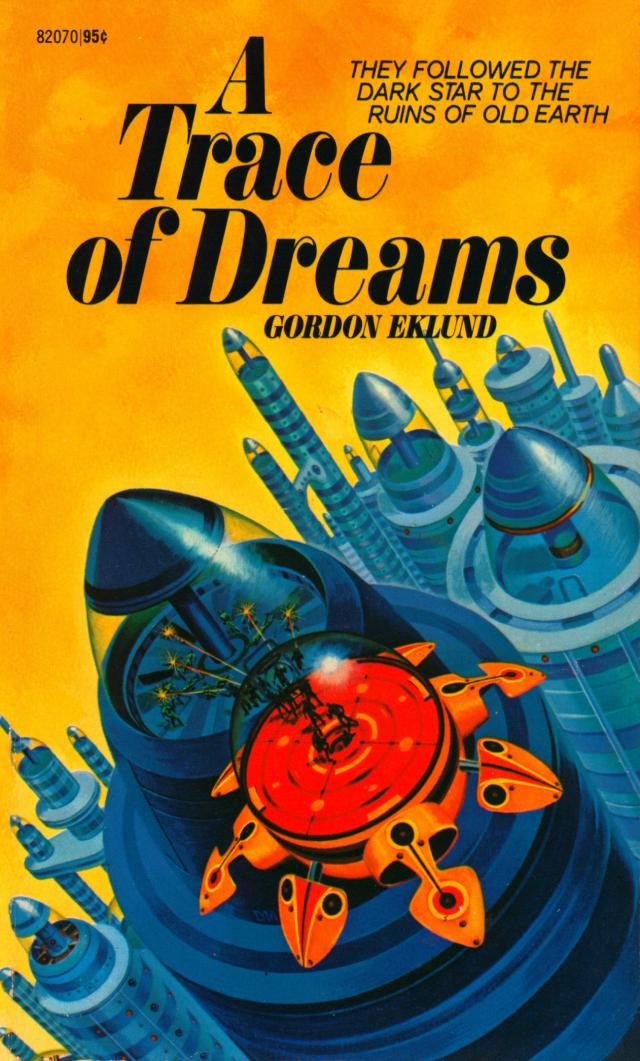
A Trace of Dreams
GORDON EKLUND
ACE BOOKS
A Division of Charter Communications Inc.
1120 Avenue of the Americas
New York, N. Y. 10036
a trace of dreams
Copyright ©, 1972, by Gordon Eklund
An Ace Book. All Rights Reserved.
author’s dedication:
For Jeremy
Printed in U. S. A.
This story is one that was told to me and my brother Nathan by grandfather, a story that was so important to the old man that he refused to tell it all to us at once, no matter how much we begged and pleaded, spacing it out instead, telling us a portion each year on our birthday (Nathan and I are twins), and not finishing the whole story for a full ten years, and not even wanting to finish it then, except he’d come finally to realize that he was going to die, and soon, and if he didn’t get the story out and done, he never would; it would die with him and be gone.
We were still living on Terxus at this time, me and Nathan and our mother and our father and of course grandfather. He wasn’t my grandfather, however, nor was he Nathan’s grandfather. What he was was my mother’s father’s grandfather, an old old man who’d spent his life going from one low-gravity planet to another, living it up for well over two hundred years, all shrunken up and bald as an egg, with a face hidden beneath blackheads and freckles and a great booming voice that sent shivers rushing through anyone it was aimed at.
Grandfather hardly spent any time at home. We saw him maybe three or four times a year, and most of the time he was home he studiously avoided the company of his contemporaries. He liked me and Nathan much better than he liked our parents, and he liked women, any woman, all woman, as long as they were a hundred and fifty or so years younger than he. This was another reason why it took so long to get the story told. Grandfather might tell us a portion when we were ten, then miss three birthdays and not get the next part told till we were fourteen. It wasn’t until later that we found out where he’d been all this time. He always said he was up in the hills mining for gold, but everybody in the settlement knew that the original survey teams had searched the hills long ago and not found a trace of gold or any other precious mineral. The truth was, it turned out, grandfather was in the hills, all right, but what he was doing was living with a Terxan woman in one of their quaint native villages. By any human standards Terxan women are not beautiful. They’re as skinny as sticks and always ugly, but grandfather apparently liked this one woman and nobody knew about it till long after he was dead. There’s no telling what the reaction would’ve been if he’d still been living when the truth got out. My father always said they’d have had two choices. They could either have hanged him for immorality, or else they could have given him a medal for conduct above and beyond all normal human expectations. (He was, after all, well over two hundred years old.)
Nathan and I were eight years old when grandfather told us the first part of the story. He didn’t forget our birthday this time and came riding down from the hills just in time to catch the tail end of the celebration. He told us he had a special treat for us, then chased everybody else away and took us outside. We were both expecting something really spectacular, but he just started talking and after a while we realized that this was the special treat, his story. It was like he was giving us an important chunk of his own life and there was nothing he had or could buy that was more precious to him.
The story took place on a planet called Meridian and happened when he wasn’t much older than we were. Meridian was an Earth-type planet that circled an Earth-type star and had fourteen moons, twelve of which were artificial and eleven of which were small. He said it wasn’t essential to the development of the story to know anything about Meridian but it always helped to know your facts and have them straight in your mind. Then he pointed his finger up at the sky where three Terxan moons lay floating and smiled and started talking.
I
One thing about James Black that struck everyone the first time they met him: he wasn’t particularly impressive. He was a tall man with long black shaggy hair but his chin was weak and his eyes were small and nearly colorless. He slumped when he stood, taking away much of the impressiveness that would normally have gone with his height, and his voice, soft and gentle most of the time, turned shrill and abrasive whenever he had to speak to more than two or three people at a time.
Despite all of this, James Black was our leader. We followed his every wish and threw down our meager lives when it was necessary, not because of his surface qualities but because of what we sensed lay within—an inner strength that was more important than a granite jaw or a powerful voice. James Black had come out of nowhere and formed his band ten years before the start of this story, five years before I joined them. When the Triad had taken power, he’d shown up in the woods with two other men (just boys, actually), and over the years and after the Triad had gone the way of all corrupt and brutal governing bodies and the Republic had come back and been equally as bad, he’d stayed out there, bringing more people into the band, doing more things with them, and staying clear of the native peoples, who were quite strange. People came out from the cities and joined him all the time, and he’d keep some of them and turn the others away, and his older men would quit or get captured or die, but all of this time he was the leader, James Black. Sometimes a new man would stray into camp, maybe coming on a whim or a dare, but thinking himself rather rough, pretty tough, and he’d meet James and you’d feel him thinking, This guy’s not so much; I could do a lot with this band, but most of the time things wouldn’t get much past the thinking stage and the man would leave, or else he’d stick around and meet some of the older members and he’d start realizing that nobody could command so much loyalty and respect without having something going for him in the first place, or else he would stay and keep on thinking and pretty soon one of the older members would take him quietly aside and explain how he was wrong in his thinking and then kill him.
Only twice that I know of did it ever get beyond this point, both times in the very early years of the band. James defeated both challengers, one with a knife and the other with a gun, without any notable trouble, and it was a long time after that (they told me, grinning) before anybody even thought poorly of James Black.
We were the Apostles of the Dark Star—Dark Star was one of the names the local media had for James Black—but to ourselves we were never anything more than just Black’s band or, simply, the band. We were just the men and women and boys and girls who’d chosen to five outside the laws of our world, the ones who’d decided that life was better when you made it to suit yourself. James Black believed in a philosophy of ultimate personal liberty, but he left most of the technical ideology to Amos Harkness. James did the fighting and Amos handled the thinking. It was an equitable arrangement for both.
The camp we occupied during my years with the band was the second one. The first had been located lower down the mountain, and it still played an important role’ in our mythology. About two years before I came, a Green army had marched in and burned it down. James had received advance warning of the raid and moved his people up to the new camp. He’d left two men behind and both had died at the hands of the raiders. The new camp was about a mile up the mountain from the first. The snows reached it a little earlier each winter and it didn’t get nearly so hot in the summer, but other than that there wasn’t much difference between the two camps.
I was fifteen when I first joined the band, coming all the way from old Earth, where I was raised and bom and nursed, coming without any particular idea of coming, just finding open passage to there and going, and landing, and hearing about Black’s band, and then going again. Fifteen years old, which made me the same age as James Black when he’d first formed the band, just him and Lester Trout and Charles Madison, both dead now along with a lot of other good men, which was only to be expected, they warned me as we rolled down the mountain, me and four other new recruits, stopping at the old camp and looking at the bones of the ones who had died, dozens of dried human skeletons lying in the yellowed grass of summer as though warning the universe of the naked futility of existence. “I’m staying,” I said immediately, looking right square at the piled bones as I spoke. “I’ve come a hundred light-years and more to find what I had to find and now that I think I’ve found it I’m not leaving by my own choice. First I’ll join those bones there.” This was exactly what they’d wanted to hear, this last sentence, the part about joining the bones, because that night, seated in a circle around James Black, the lieutenants made their decision. I was unanimously chosen to join the band, but of the four recruits, three were turned down flat and the fourth barely made it by two votes. The three losers were taken down the mountain to the old camp and placed there among the other bones. We two winners were required to do the placing.
The usual number of people in camp ranged from less than fifty to no more than seventy-five. It was impossible to feed more than that off the meat we stole from the settlement below. About one person in five was usually a woman. The rest, men and boys, ranged in age from thirteen and fourteen up to maybe thirty-five. We never had very many older people coming out to join us, and the few that did were almost always turned down. Everybody knew that the older a man was, the less chance he had of being able to hold up his share of the load. The only real exception to this was Amos Harkness. Harkness was close to sixty with bristly white hair and thick steel-rimmed spectacles, the real kind, over harsh flat blue eyes. In the better days he’d been a professor at the university down in the city (and before that a professor at other universities on other planets going all the way back to old Earth, where he’d been bom and raised and nursed), but when the Triad had taken control he’d refused to change either his teachings or his beliefs. At first they’d put him in prison with chains and tortured him, then sentenced him to death, but on the night before his scheduled execution, he’d managed to pull a daring escape. He’d run for the mountain and joined Black’s band, which then numbered about fifteen people, all of them boys of twenty or less. After the ouster of the Triad a few months later, Amos had refused to accept his pardon. He’d said we’d only lost one enemy and gained another just as evil, only less obvious about it. James and the rest of the band had all agreed with Amos. During the period of the amnesty they’d remained on the mountain, and when it was over, they’d gone back to fighting again.
When the big bell in the community center rang, it was a signal for everybody within earshot to drop whatever it was they were doing and come running.
When it rang that day in the middle of a long and restful summer, just two days after the day I’d received my commission as a lieutenant, I was lying outside the camp at the edge of the creek with a girl of seventeen with a pleasant face whose name was Loyola. I’d started keeping company with her about a week previous and she hadn’t been with us long. She had long dark hair flowing down her back and a cute little girl’s face which didn’t seem to know any expression except a smile. I’d received my commission because of the abrupt death of Jack Olsen, killed the week before by an unknown sniper. I was proud of my advancement, even under the circumstances, because at twenty I was easily the youngest lieutenant in the band.
I don’t remember exactly what Loyola and I were doing that day by the creek when the bell rang, but whatever it was, I know we stopped immediately, put ourselves back together and ran toward the camp.
We’d been farther away from the camp than people were normally allowed to stray—but as a lieutenant, I was able to rule my own movements—and as a result, we were among the last to arrive at the community center, both panting, Loyola smiling, and then we turned to face the stage.
James Black stood there in front of us. The stage put his waist above the level of our eyes and he spoke loudly.
He said, “The reason for this meeting is simple. I’ve decided to head a raid today on the Big Mountain settlement. I know this comes out of turn, but we’re not going down there to gather supplies. We’ve already got more than enough food to last out the summer. What we’re going down there after is retribution. Somebody from down there—and it wasn’t a soldier—came up here one night last week and killed Jack Olsen. I don’t intend to let this pass without hitting back, so I’m calling on ten people to go down there with me. We’re going to make a little mischief in memory of Jack. The people I have selected are…and he read a list of ten names. I was on it and so was Loyola.
The others went away while those of us who had been selected waited for James. This was the way he always ran things. He’d make his announcements only minutes before the plans were turned into actions. He left no room for discussion or argument. Sometimes he would talk things over first with his lieutenants, but not often, only when something big was brewing. Otherwise, the only counsel he ever sought was that of Amos Harkness.
When the others had left, James told us, “Get your weapons and meet me at the creek in ten minutes, no more,” then walked away.
I went back to my tent and got my knife and rifle. As a lieutenant, I was authorized to have a tent of my own, but my old roommate hadn’t finished moving yet. He tried to question me but I turned a cold ear on his inquiries and said he better be gone by the time I got back. His questions had put me in a foul mood. You could never be sure when a loyalty check was occurring or not.
On the way to the creek, I was joined by some of the other men who were going on the raid. We walked together, and when we arrived, James was already there ahead of us. He bunched us together and then told us what we’d be doing. Mostly he just repeated the few things he’d said from the stage. We were going down to the settlement. The idea was to hit them, hurt them, and then get away as fast as possible. It all sounded simple enough to me.
There was one other lieutenant in the party besides me, a man named Ben Steiner. He and I lined out eight men into a neat column and marched them off. We weren’t a military outfit and never tried to be, so we didn’t bother trying to make people keep step or anything mechanical like that. We wanted to keep everyone together but that was only because it was easier to act quickly in the event of a sudden emergency.
James took his usual spot at the rear and Ben took the head of the column. I walked at the side for a time, then slipped into formation behind Loyola. We moved down the twisting mountain trail with fresh clean air sweeping over us like water and bright blooming flowers slipping past in clumps before we even had a chance to see them dance and change. I leaned forward and talked into Loyola’s ear as we marched. She seemed to enjoy what I said, softly laughing as we walked.
Like me, I knew, she was only trying to calm her nerves. This was her first raid, and although I’d been on plenty, this was my initial time out as an officer. Now, instead of just myself, I was partially responsible for the safety of seven men and a girl. It was hard getting myself accustomed to this, so I helped pass the time by laughing and chatting. It was human enough.
The Big Mountain settlement was about four hours from camp. The main feature of the settlement was the food-processing factory where chemicals were combined with natural substances to make bread and other basic foods for human consumption. The settlement had been build around the factory. There were a few stores and houses farther down the mountain past the factory, but not much else.
We were about a quarter of the way to the settlement when the video crew joined the caravan, their cameras darting among us like flying insects, moving in for tight emotive close-ups, then drifting back to give the wider, more objective view. I found it difficult to keep myself from hamming it up for them, but James, who was used to it, never changed his demeanor, even when a camera was rammed right square in his face. He just kept walking, smiling sometimes, looking left, looking right, looking to the rear. His celebrity status meant nothing to him. Primarily (and properly) he thought of himself as a warrior in tbe cause of liberty.
For people like Loyola and me, it wasn’t so easy. I’d participated in more than my share of raids, but I still hadn’t accustomed myself to the presence of the cameras. Once the actual fighting began, I knew things would be much better and I’d have no trouble ignoring everything else, what with my life at stake, but before that, when there was nothing going but a lot of walking and waiting, I had my troubles. I could tell it was bothering Loyola too. As the only girl in the party, she was getting more than her share of coverage, so I stopped whispering in her ear and contented myself with following her step. She smiled self-consciously whenever the cameras were pointed in her direction, but there was nothing I could do about it. I knew from experience that most of this preliminary footage would later be edited or junked, maybe only a minute or two of it ever getting out, but I didn’t tell her this. I couldn’t be sure in advance whether it would help or hinder her performance.