The future makers v1 0, p.1
The Future Makers (v1.0), page 1


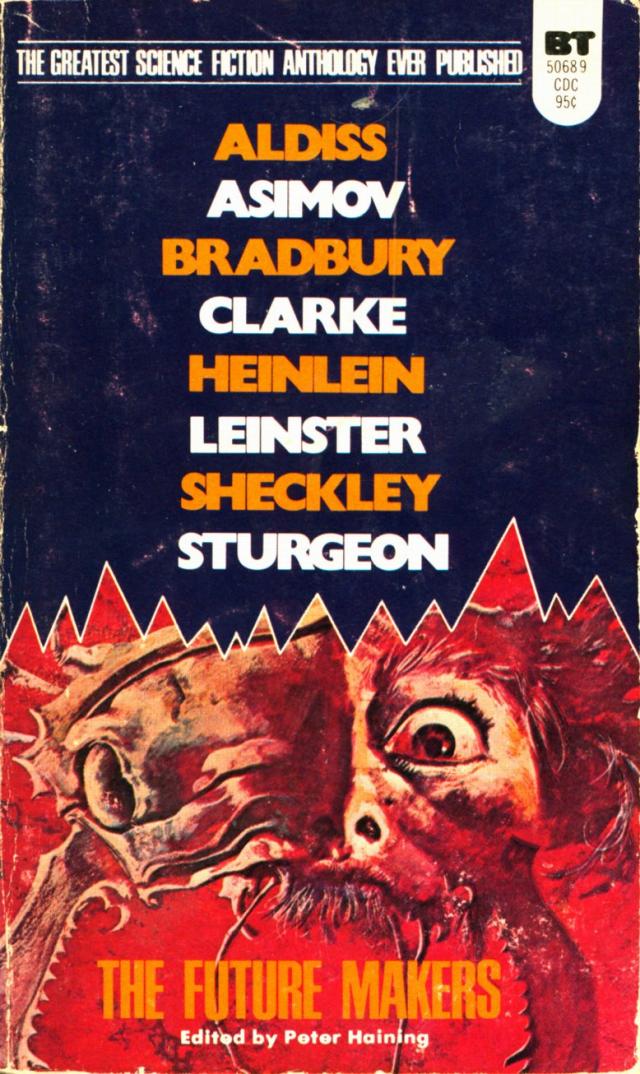
A SUPERB COLLECTION
BY EIGHT OF THE WORLD’S BEST
SCIENCE FICTION WRITERS:
BRIAN W. ALDISS
“EQUATOR”
ISAAC ASIMOV
“THE WEAPON TOO DREADFUL TO USE”
RAY BRADBURY
“THE PIPER”
ARTHUR C. CLARKE
“CASTAWAY”
ROBERT HEINLEIN
“COLUMBUS WAS A DOPE”
MURRAY LEINSTER
“THE FOURTH DIMENSIONAL DEMONSTRATOR”
ROBERT SHECKLEY
“THE HOUR OF BATTLE”
THEODORE STURGEON
“ABREACTION”
SCIENCE FICTION MASTERPIECES FROM
THE MASTERS OF SCIENCE FICTION.
Our free catalogue is available upon request. Any titles not in your local bookstore can be purchased through the maiL Simply send 151 plus the retail price of the book and write Belmont Tower Books, 185 Madison Avenue, New York, New York 10016.
Any titles currently in print are available in quantity for industrial and sales-promotion use at reduced rates. Address inquiries to our Promotion Dept.
THE
FUTURE
MAKERS
Edited by
Peter Haining
BELMONT TOWER BOOKS • NEW YORK CITY
A BELMONT TOWER BOOK—June 1974
Published by
Belmont Tower Books
185 Madison Avenue
New York, N.Y. 10016
Copyright © 1968 by Peter Halning
All rights reserved
Printed in the United States of America
For My Father who taught me the value of heritage.
Contents: -
ACKNOWLEGEMENTS
INTRODUCTION
THE FOURTH DIMENSIONAL DEMONSTRATOR
By Murray Leinster
THE WEAPON TOO DREADFUL TO USE
By Isaac Asimov
ABREACTION By Theodore Sturgeon
THE PIPER By Ray Bradbury
COLUMBUS WAS A DOPE By Robert Heinlein
CASTAWAY Arthur C. Clarke
THE HOUR OF BATTLE By Robert Sheckley
EQUATOR By Brian Aldiss
ACKNOWLEGEMENTS
The editor is grateful to the following authors, their publishers and agents, for permission to reproduce copyright stories in this collection: “The Fourth Dimensional Demonstrator” by Murray Leinster © 1935 by Street and Smith Publications Inc., reprinted by permission of the author. ’The Weapon Too Dreadful To Use” by Isaac Asimov © 1939 by Amazing Stories; reprinted by permission of the author. “Abreaction” by Theodore Sturgeon © 1939 by Weird Tales; reprinted by permission of the author. “The Piper” by Ray Bradbury © 1943 by Thrilling Wonder Stories; reprinted by permission of the author. “Columbus Was a Dope” by Robert Heinlein © 1947 by Startling Stories; reprinted by permission of the author. “Castaway” by Arthur C. Clarke © 1947 by Fantasy; reprinted by permission of the author. “The Hour of Battle” by Robert Sheckley © 1953 by Space Science Fiction; reprinted by permission of the author. “Equator” by Brian W. Aldiss © 1958 Nova Publications Ltd; reprinted by permission of the author.
INTRODUCTION
The eight contributors to this volume are probably today’s most distinguished Science Fiction authors—their names are familiar to every fan and their reputations as storytellers have spread far beyond the bounds of the genre. They are all professionals, in fact; imaginative, painstaking, and dedicated writers who have mastered their craft and the ability to communicate a new idea, theme, or concept.
Today we take the brilliance of these eight men—for such it undoubtedly is—almost for granted. We wait eagerly for each new story or novel, confident in the knowledge that it will be at least as good, if not even better, than previous works. They can never overproduce where the vociferous fan is concerned—but wisely do not even try. Yet, like all true craftsmen, they did go through a period of apprenticeship when their names meant very little to readers and they worked industriously through the pages of small magazines and in the face of discouragingly small payments to develop and perfect styles which were eventually to earn them their worldwide acclaim.
This anthology is an excursion back in time to those early years of the eight men; a selection from the archives of Science Fiction of a group of stories which illustrate the formation of the technique each man was making particularly his own. The tales I have chosen are all typical of the kind which they produced during their apprenticeship; one or two are even their author’s very first efforts. All have been out of print and are probably, in the main, unknown to today’s new generation of readers. They show styles emerging and imaginations beginning to range over new ground—but do not judge them against their author’s most modem and highly-tempered work, rather for their own sake and their value as “period” Science Fiction. Nonetheless, I believe you will find the standard of them all is quite astonishing.
Meet, now, The Future Makers—for together these stories present a totally fresh angle on the men who have shaped modem S.F.
PETER HAINING
1968
THE FOURTH
DIMENSIONAL DEMONSTRATOR
By Murray Leinster
Murray Leinster is unquestionably “The Dean of Science Fiction Writers*’. In a lifetime that spans over seventy years, he has won for’himself an enduring reputation for writing stories of great imagination and often uncanny prophecy. His first published story in the genre, “The Runaway Skyscraper* appeared in 1919 and in the interim he has won a Hugo Award, been many times nominated a top writer in Science Fiction and Fantasy magazines and developed his private interest in science to such an extent that one of his inventions—a method of making films without sets in which actors perform against projected backgrounds—is continually put to use by American T.V. and film companies. But above all else, it is stories like the one here—which Sam Moskowitz calls “one of the funniest stories ever to appear in Science Fiction”—which have established for him a permanent place in the great hall of Science Fiction.
Pete Davidson was engaged to Miss Daisy Manners of the Green Paradise floor show. He had just inherited all the properties of an uncle who had been an authority on the fourth dimension, and he was the custodian of an unusually amiable kangaroo named Arthur. But still he was not happy; it showed this morning.
Inside his uncle’s laboratory, Pete scribbled on paper. He added, and ran his hands through his hair in desperation. Then he subtracted, divided and multiplied. But the results were invariably problems as incapable of solution as his deceased relative’s fourth-dimensional equations. From time to time a long, horselike, hopeful face peered in at him. That was Thomas, his uncle’s servant, whom Pete was afraid he had also inherited.
“Beg pardon, sir,” said Thomas tentatively.
Pete leaned harassedly back in his chair.
“What is it, Thomas? What has Arthur been doing now?”
“He is browsing in the dahlias, sir. I wished to ask about lunch, sir. What shall I prepare?”
“Anything!” said Pete. “Anything at all! No. On second thought, trying to untangle Uncle Robert’s affairs calls for brains. Give me something rich in phosphorus and vitamins; I need them.”
“Yes, sir,” said Thomas. “But the grocer, sir—”
“Again?” demanded Pete hopelessly.
“Yes, sir,” said Thomas, coming into the laboratory. “I hoped, sir, that matters might be looking better.”
Pete shook his head, regarding his calculations depressedly. “They aren’t. Cash to pay the grocer’s bill is still a dim and misty hope. It is horrible, Thomas! I remembered my uncle as simply reeking with cash, and I thought the fourth dimension was mathematics, not debauchery. But Uncle Robert must have had positive orgies with quanta and space-time continual I shan’t break even on the heir business, let alone make a profit!”
Thomas made a noise suggesting sympathy.
“I could stand it for myself alone,” said Pete gloomily. “Even Arthur, in his simple kangaroo’s heart, bears up welL Birt Daisy! There’s the rub! Daisy!”
“Daisy, sir?”
“My fiancee,” said Pete. “She’s in the Green Paradise floor shew’. She is technically Arthur’s owner. I told Daisy, Thomas., that I had inherited a fortune. And she’s going to be disappointed.”
“Too bad, sir,” said Thomas.
“That statement is one of humorous underemphasis, Thomas. Daisy is not a person to take disappointments lightly. When I explain that my uncle’s fortune has flown off into the fourth dimension, Daisy is going to look absent-minded and stop listening. Did you ever try to make love to a girl wh*> looked absent-minded?”
“No, sir,” said Thomas. “But about lunch, sir—”
“We’ll have to pay for it. Damn!” Pete said morbidly. “I’ve ju^t forty cents in my clothes, Thomas, and Arthur, at least, mustn’t be allowed to starve. Daisy wouldn’t like it. Let’s see!”
He moved away from the desk and surveyed the laboratory with a predatory air. It was not exactly a homey place. There was a skeletonlike thing of iron rods, some four feet high. Thomas had said it was a tesseract—a model of cube existing in four dimensions instead of three.
To Pete, it looked rather like a medieval instrument of torture—something to be used in theological argument with a heretic. Pete could not imagine anybody but his uncle wanting it. There were other pieces of apparatus of all sizes, but largely dismantled. They lo oked like the product of some one putting vast amounts of money and patience into an effort to do something which would be unsatisfactory when accomplished.
“There’s nothing here to pawn,” said Pete depressedly. “Not even anything I could use for a hand organ, with Arthur substituting for the monkey!”
’There’s the demonstrator, sir,” said Thomas hopefully. “Your uncle finished it, sir, and it worked, and he had a stroke, sir.”
“Cheerful!” said Pete. “What is this demonstrator? What’s it supposed to do?”
“Why, sir, it demonstrates the fourth dimension,” said Thomas. “It’s your uncle’s life work, sir.”
“Then let’s take a look at it,” said Pete. “Maybe we can support ourselves demonstrating the fourth dimension in shop windows for advertising purposes. But I don’t think Daisy will care for ^he career.”
Thomas marched solemnly to a curtain just behind the desk. Pete had thought it hid a cupboard. He slid the cover back and displayed a huge contrivance which seemed to have the solitary virtue of completion. Pete could see a monstrous brass horseshoe all of seven feet high. It was apparently hollow and full of cryptic cogs and wheels. Beneath it there was a circular plate of inch-thick glass which seemed to be designed to revolve. Below that, in turn, there was a massive base to which ran certain copper tubes from a refrigerating unit out of an ice box.
Thomas turned on a switch and the unit began to purr. Pete watched.
“Your uncle talked to himself quite a bit about this, sir,” said Thomas. “I gathered that it’s quite a scientific triumph, sir. You see, sir, the fourth dimension is time.”
*“I’m glad to hear it explained so simply/* said Pete.
“Yes, sir. As I understand it, sir, if one were motoring and saw a pretty girl about to step on a banana peel, sir, and if one wished to tip her off, so to speak, but didn’t quite realize for—say, two minutes, until one had gone on half a mile—”
“The pretty girl would have stepped on the banana peel and nature would have taken its course,” said Pete.
“Except for this demonstrator, sir. You see, to tip off the young lady one would have to retrace the half mile and the time too, sir, or one would be too late. That is, one would have to go back not only the half mile but the two minutes. And so your uncle, sir, built this demonstrator—”
“So he could cope with such a situation when it arose,” finished Pete. “I see! But I’m afraid it wont settle our financial troubles.”
The refrigeration unit ceased to purr. Thomas solemnly struck a safety match.
“If I may finish the demonstration, sir,” he said hopefully. “I blow out this match, and put it on the glass plate between the ends of the horseshoe. The temperature’s right, so it should work.”
There were self-satisfied clucking sounds from the base of the machine. They went on for seconds. The huge glass plate suddenly revolved perhaps the eighth of a revolution. A humming noise began. It stopped. Suddenly there was another burnt safety match on the glass plate. Tlie machine began to cluck triumphantly.
“You see, sir?” said Thomas. “It’s produced another burnt match. Dragged it forward out of the; past, sir. There was a burnt match at that spot, until the glass plate moved a few seconds ago. Like the girl and the banana peel, sir. The machine went back to the place where the match had been, and then it went back in time to where the match was, and then it brought it forward.”
The plate turned another eighth of a revolution. The machine clucked and hummed. The humming stopped. There was a third burnt match on the glass plate. The clucking clatter began once more.
“It will keep that up indefinitely, sir,” said Thomas hopefully.
“I begin,” said Pete, “to see the true greatness of modern science. With only two tons of brass and steel, and at a cost of only a couple of hundred thousand dollars and a lifetime of effort, my Uncle Robert has left me a machine which will keep me supplied with burnt matches for years to come! Thomas, this machine is a scientific triumph!”
Thomas beamed.
“Splendid, sir! I’m glad you approve. And what shall I do about lunch, sir?”
The machine, having clucked and hummed appropriately, now produced a fourth burnt match and clucked more triumphantly still. It prepared to reach again into the hitherto unreachable past.
Pete looked reproachfully at the servant he had apparently inherited. He reached in his pocket and drew out his forty cents. Then the machine hummed. Pete jerked his head and stared at it.
“Speaking of science, now,” he said an instant later. “I have a very commercial thought. I blush to contemplate it.” He looked at the monstrous, clucking demonstrator of the fourth dimension. “Clear out of here for ten minutes, Thomas. I’m going to be busy!”
Thomas vanished. Pete turned off the demonstrator. He risked a nickel, placing it firmly on the inch-thick glass plate. The machine went on again. It clucked, hummed, ceased to hum—and there were two nickels. Pete added a dime to the second nickel. At the end of another cycle he ran his hand rather desperately through his hair and added his entire remaining wealth—a quarter. Then, after incredulously watching what happened, he began to pyramid.
Thomas tapped decorously some ten minutes later.
“Beg pardon, sir,” he said hopefully. “About lunch, sir—”
Pete turned off the demonstrator. He gulped.
“Thomas,” he said in careful calm, “I shall let you write the menu for lunch. Take a basketful of this small change and go shopping. And—Thomas, have you any item of currency larger than a quarter? A fifty-cent piece would be about right. I’d like to have something really impressive to show Daisy when she comes.”
Miss Daisy Manners of the Green Paradise floor show was just the person to accept the fburth-dimensional demonstrator without question and to make full use of the results of modem scientific research. She greeted Pete abstractedly and interestedly asked just how much he’d inherited. And Pete took her to the laboratory. He unveiled the demonstrator.
“These are my jewels,” said Pete impressively. “Darling, it’s going to be a shock, but—have you got a quarter?”
“You’ve got nerve, asking me for money,” said Daisy. “And if you lied about inheriting some money—”
Pete smiled tenderly upon her. He produced a quarter of his own.
“Watch, my dear! I’m doing this for you!”
He turned on the demonstrator and explained complacently as the first duckings came from the base. The glass plate moved, a second quarter appeared, and Pete pyramided the two while he continued to explain. In the fraction of a minute, there were four quarters. Again Pete pyramided. There were eight quarters—sixteen, thirty-two, sixty-four, one hundred twenty-eight—At this point the stack collapsed and Pete shut off the switch.
“You see, my dear? Out of the fourth dimension to you! Uncle invested it, I inherited it, and—shall I change your money for you?”
Daisy did not look at all absent-minded now. Pete gave her a neat little sheaf of bank notes.
“And from now on, darling,” he said cheerfully, “whenever you want money just come in here, start the machine—and there you are! Isn’t that nice?”
“I want some more money now,” said Daisy. ‘1 have to buy a trousseau.”
“I hoped you’d feel that way!” said Pete enthusiastically. “Here goes! And we have a reunion while the pennies roll in.
The demonstrator began to cluck and clatter with bills instead of quarters on the plate. Once, to be sure, it suspended all operations and the refrigeration unit purred busily for a time. Then it resumed its self-satisfied delving into the immediate past.