The descent, p.1
The Descent, page 1


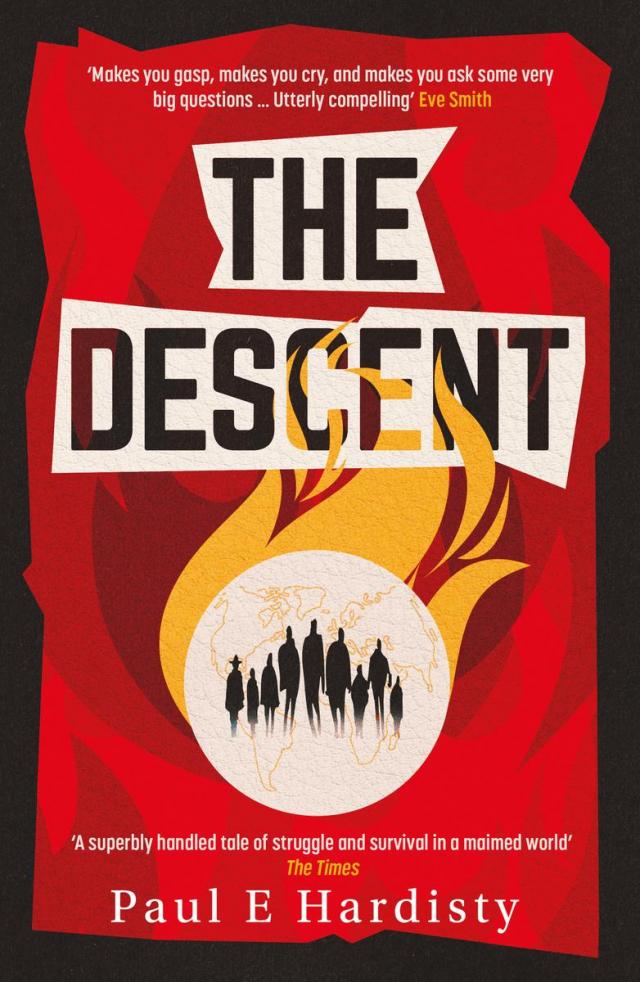
Kweku Ashworth is a child of the cataclysm, born on a sailboat to parents fleeing the devastation in search for a refuge in the Southern Ocean. Growing up in a world forever changed, his only connection to the events that set the planet on its course to disaster were the stories his step-father, now long dead, recorded in his manuscript, The Forcing.
But there are huge gaps in his step-father’s account, and when Kweku stumbles across a clandestine broadcast by someone close to the men who forced the globe into a climate catastrophe, he knows that it is time to find out for himself.
Determined to learn what really happened, Kweku and his young family set out on a perilous voyage across a devastated planet. What they find will challenge not only their faith in humanity, but their ability to stay alive.
The Descent is the devastating, nerve-shattering prequel to the critically acclaimed thriller The Forcing, a story of survival, hope, and the power of the human spirit in a world torn apart by climate change.
The Descent
PAUL E HARDISTY
Contents
Title Page
Ghosts
February 2024
Short-Wave
March 2024
Mother
April 2024
Sister
May 2024
Juliette
June 2024
Jennifer
July 2024
Francoise
August 2024
Persephone
Scavengers
Niece
October 2024
Port Louis
November 2024
Indian Ocean
December 2024
Ocean Transporter
January 2025
Fema
July 2025
Goddesses
Peace
November 2025
Women
December 2025
Insects
January 2026
Bones
March 2026
Calypso
July 2026
Lioness
September 2026
Patricia
October 2026
Lotus Eaters
March 2027
Athena
Mortals
Cape Town
August 2027
Matriarchy
September 2027
Takoradi
April 2028
Xoese
January 2029
Kejabil
July 2029
Grandmother
August 2029
Jumelle
Prisoners
Paramaribo
Sept 2029
Trust
October 2029
Elvira
May 2030
Grenada
November 2030
Nemesis
February 2031
Isabella
Orphans
Hecate
January 2032
Panama
December 2032
Marlin
May 2033
Wife
January 2034
Orion Star
April 2035
Beloved
December 2036
Akua
September 2037
Rebecca
March 2038
Freyja
Witnesses
The Hope
February 2039
Daughters
February 2039 – final entry
Earth
About the Author
Also by Paul E. Hardisty and available from Orenda Books
Copyright
It is always the same. She lifts me up and spins me around, a whirling explosion of colour. The blue of the sky, her hair a wind-blown cloud of sunlight, the water of the lagoon that exquisite aquamarine of my dreams. Palm fronds sway in the ocean breeze and the sound they make is like breathing. There is someone else there with us, just out of reach, someone I should know, and there is a threshold there, right there, but each time I get close and try to cross, it moves away, beckoning me deeper. She glances sidelong, something hiding behind her smile, and then she faces me and her eyes have gone cold and black, and then there is nothing there at all, just two fathomless sockets in a screaming skull and I am sinking deeper and deeper and the urge to breathe comes and then the spasms as the consumed oxygen bonds and builds and I can see that bright-blue surface falling away above me, and I know that I am drowning.
Ghosts
February 2024
The scientist squared the edges of his notes, adjusted his glasses and stared out at them with a nervous smile. It looked like he’d slept in his clothes, and he probably had. Though the room was AC cold, perspiration sheened his forehead and rolled like tears down his neck. He ran a finger under his too-tight collar and loosened his ill-matched tie. His name was James Trig, Professor James Trig, and he had a PhD in advanced computational simulation from MIT and several postdocs in atmospheric science and Earth-system dynamics. He looked fit, not the big, muscled gym type but the slender cyclist or runner’s build that I’ve always been partial to. At the time of the meeting, he was forty-two years old, married with two children ages twelve and ten. He’d been on the payroll now for over a year, but this was the first time they’d asked him for a briefing.
Yu Wan leaned back in his chair at the head of the table and lifted his index finger towards the ceiling, held it there until the only thing you could hear was the dull hum of the gardener’s leaf blower coming through the bulletproof picture windows from somewhere down by the lake. Then he turned his finger in an arc until its tip met the old-growth hardwood mahogany on the vertical.
‘Begin, Professor,’ he said. Wan’s voice was thin and he spoke very quietly so you had to listen hard to hear everything he said. And it was worth your while, because he hated repeating himself.
Trig cleared his throat and put up his first slide. It was a graph of global average surface temperature differences from the 1901 to 2000 average, going back to 1890. Before 1940, all the bars were blue, meaning negative, below the average. Between 1940 and 1975 some were blue, but lots were red – above the average. After 1975 they were all red, growing left to right like the skyline of a booming city, Dubai, say, or Shanghai.
Trig began. ‘This, gentlemen’ – for they were all men there, the ones who mattered – ‘is the very best data we have, collected and verified from the world’s leading science institutions. As you can see, global surface temperatures have been climbing inexorably for the past six decades and have accelerated markedly since 1981. The ten warmest years on record have been since 2010. And 2023, the year just gone, has now been officially declared the warmest year on record, beating last year, which beat the year before that.’
My boss coughed and pushed back his chair. ‘Yeah right,’ he said under his breath.
Trig glanced at my boss, moved to his next slide, a Mercator projection of the world coloured different shades of red and orange and yellow. It looked like one of my dad’s old lava lamps. The title was ‘Temperature Trends Since 1990’.
My boss coughed again, that thing he does when he’s not happy. I could see Trig’s Adam’s apple moving under the badly shaved skin of his neck as he swallowed once, then twice, then reached for a glass of water and drank.
We’d lured him away from a senior science position with the National Oceanographic and Atmospheric Administration, enticed him with ten times his normal salary – which wasn’t that much, actually, I was surprised. He also got a nice new car, a house and unlimited first-class travel. He was, apparently, one of the world’s best at what he did. By then we had a lot of scientists on the payroll, but this guy was different, he knew his stuff, and unlike the others, he was not allowed to speak publicly about his work, or publish. That was the deal. We set him up in his own laboratory on a remote property on the West Coast, and gave him a budget so big that when we showed him the number I thought he was going to pass out. He’d come across enthusiastically.
‘This, ah …’ Trig stumbled, continued. ‘This shows the increase in temperatures up to 2023. The thing here is that warming is not the same everywhere on the planet. You can see that the Arctic is all red, and that the Northern Hemisphere, where most of the land is, has warmed much faster than the rest of the world.’
He fumbled with his laser pointer, and the red dot quivered on the ceiling then flashed across the wall before coming to rest on an area of white down at the southern part of Africa. The dot jumped with his pulse. His heart was racing.
‘Areas like the southern cone of Africa, the southern tip of Madagascar, the south-west coast of Australia, New Zealand, and parts of the Pacific have all warmed much less than the average and some not at all.’
By then I could tell from the veins in my boss’s neck that he’d had enough. He stood, put both his fists on the table and sent his gaze around the room. ‘Same old shit we’ve been hearing for forty years,’ he flexed.
‘Sit down, Derek,’ said Wan. You could barely hear him.
My boss stood there a moment, appealing to his colleagues with those glacier-blue eyes, finally fixing on Yu Wan.
Wan stared back hard, and for a moment neither moved and all we could hear was the hum of the projector and the leaf blower still at it somewhere further away now.
Then my boss smiled, that big, amazing smile that he has, that he seemed to be able to switch on whenever he needed it, that he could direct in a way that made you think it was only for you. I swear, people would literally fall in love with him after having that smile directed at them, even when he was trying to throw shade. Then he looked over at me. ‘Do I have anything better to do right now?’
‘No, sir,’ I said. ‘Nothing until this afternoon.’
He winked at me, just a flash of ice, that way he did.
I smiled, could feel the heat rising in my cheeks, such a girl thing to do.
My boss said: ‘Well, I guess I can stay then.’ He sat back in his chair. ‘But get to the punchline, would ya, Professor?’
Yu Wan shook his head and sighed like an annoyed and slightly embarrassed parent. After that Trig spoke quickly, skipping some slides altogether. And then he came to the punchline. Despite all the rhetoric and the efforts of the United Nations and the pledges of governments around the world – that got a laugh from the whole room – there was now little hope that the planet’s temperature could be kept within acceptable, safe limits.
‘And what does that mean for us?’ said Pierre Valliant in that strong French accent of his.
‘Well,’ said Trig, ‘in terms of the release of heat stored in the oceans —’
‘No,’ said my boss, an expert in the art of interrupting. ‘Not the mumbo-science-jumbo. What does it mean for us?’
Trig glanced around the room, the laser-pointer-clicker hanging limp in his hand. ‘Well, I … if you’re asking about the economic consequences, it’s not really my area of expertise.’
‘Translate the physical,’ said Valliant. ‘Guess.’
‘Guess?’ stammered Trig.
Yu Wan nodded.
Trig took a deep breath. I could see his lungs rising and falling under his unironed and by now sweat-stained shirt. ‘Well, if things don’t change and emissions continue to track on their current course, widespread drought, fire, flood, significant changing of ecosystems, poleward shift of species that are able to move, extreme weather of all kinds, basically a lot more of what we’ve seen in the last few years.’
‘Seriously,’ said my boss. ‘How many degrees does this guy have? Can’t even understand a simple fucking question. Can someone please tell this egghead to get to the point?’
By now Trig was melting down. I’d seen my boss do that to people before, turn them into quivering masses of pure fear, and I was pretty sure that he enjoyed it. Power is such a turn-on for some people, I know.
Yu Wan raised his hand, shot my boss a warning look. ‘Please, Professor, continue.’
I could see Trig making a supreme effort to compose himself. Even then, his voice came out sounding as if someone was choking him with both hands. ‘Worst case,’ he rasped, ‘biological, social and economic collapse.’
He stopped there and everyone sat listening to the rattle of the AC and the interminable drone of that leaf blower.
Short-Wave
Two years to the day after Papa died, I read his manuscript over again from start to finish. It takes me the whole day and all of that night. I read until my eyes are burning and my heart is breaking.
The next morning, I walk up the hill to the little stone building that Lewis and I built the year Papa died. It was Lewis’s idea, doing this. He’d made successive trips to Albany, worked with a friend of his and brought back all the necessary components, including the five-metre antenna. Shortly after, we started the weekly readings. We’d both read Papa’s story about him and the others who were blamed for killing the old world that everyone seemed to love so much but not quite enough to save. And we decided that we needed to do whatever we could to tell whoever might be left out there about what he’d seen. Mum, too. It was her story as much as his.
From the top of the ridge, I can see all the way back down to Mum’s place and the cove where Providence rests head to wind on her mooring, the one Papa put in all those years ago when I was still just a little boy and we’d arrived here and decided to stay. Further out, the headland we call The Hope glows for a moment in the sun and then vanishes behind a veil of rain. I glance up at the antenna, open the door and then open the shutters.
I sit in front of the set, place Papa’s manuscript on the table in front of me, the one he called The Forcing. I open it at chapter nineteen, the part where Samantha Argent is executed. I turn on the transmitter, watch the dials come to life, position the microphone. We are broadcasting on 4.75 megahertz, bouncing our signal off the ionosphere and out to the world. A chapter a week is what we agreed on – pick a frequency and keep it there. And so far, we have heard absolutely nothing back.
I read the chapter, slowly and clearly. The short waves can travel thousands of miles. It is only a matter of someone out there somewhere being able to pick them up. When I’m done, I sit a moment staring at the glowing dials, these vestiges of another world, another time, the sigh of the empty carrier wave coming to me over the headphones.
The electricity flowing through the transmitter is provided by a solar array Lewis set up nearby, another salvaged echo. I always marvel at my younger brother’s aptitude for anything mechanical. He’s a genius, I reckon, or near enough.
I am about to shut down when the frequency crackles. There is a moment of silence and then a heavily distorted voice is there in my head. I can’t make out what the voice is saying, but a moment later the signal clears up.
‘To the boys telling us the story of The Forcing. Keep going. People need to know … Here is my part.’
I see Lewis standing outside and I wave to him through the window, signal for him to come inside. He runs in. I take off the headphones and unplug the jack so we can both hear.
We sit enraptured as she speaks, her voice warbling across the reflected miles. She recounts events of almost half a century ago, the time of my parents. It is as if we are living it with her, and as we listen, we can hear the years in her voice, and in her words we can glimpse the young woman she once was.
After she is finished there is a pause, and then she says: ‘To whoever is broadcasting on this frequency. Please respond.’
‘We receive you,’ I blurt out. ‘This is Australia.’
The frequency wavers, clears. ‘Received, Australia. Thanks for your broadcasts. I thought I was alone.’
I key the microphone. ‘So did we. Who is this, please?’
Lewis is standing beside me, a big smile on his face, his hand on my shoulder.
‘That’s not important,’ comes the voice in reply. ‘Just know that what you are doing is very important … And very dangerous.’
‘Dangerous?’ I key back. ‘Dangerous how?’
‘They are listening.’
‘Who? Who is listening?’
We wait, the wave hissing over the speaker, but nothing comes back. The transmission is over.
March 2024
Three weeks before the Boss’s big flight, we took the Gulfstream G800 to Paris for the weekend. The trip was part business and part pleasure, although I was never sure if business was the pleasure for the Boss, and the stuff he did with his wife was the chore. It was that way with him, with all of those guys, just go wherever they wanted at a moment’s notice, the jet always waiting, ready to go, the rest of us lackeys left scrambling to organise accommodation and events and the whole business.
The Boss’s wife arrived at the airstrip in her own limo. He pulled up a while later in his new whip, a black Ferrari. It was a beautiful car. He’d even taken me for a ride in it a few times, those leather seats so soft on my bare legs and ass. That’s how he liked me, short skirts and pumps.
Before I am judged, in my defence I was very young, just out of college, armed with my shiny BA in psychology, working as a waitress in a swank restaurant in New York when we first met. He’d bought up the whole place for a big do, had flown in a bunch of politicians from Malaysia, all the dirty old men travelling without their wives, and he offered me ten thousand dollars just to be nice to these guys. You know, smile, wiggle my ass a bit when I walked, sit on their laps and put food in their mouths, that kind of thing. I had to slap one of them when he tried to grope me, but the Boss made it clear that I was off limits that way, and I could see they were all scared shitless of him, so there was no repeat. At the end of the night, he left me a card and told me to call him. There was a full-time job if I wanted it. A quarter of a mil a year. I told him to go fuck himself, not very smart but I was thinking no f’n way was this real. He just laughed that way he did, like there was nothing in the world that he couldn’t do, and well, there I was, flying to Paris in a private jet. That’s the way he was. He got what he wanted.