Bedbugs, p.1
Bedbugs, page 1


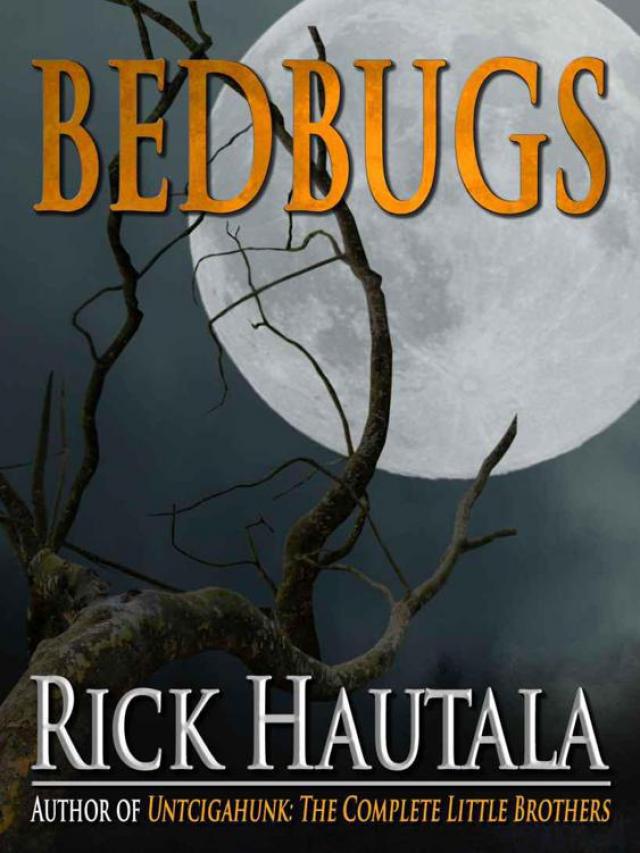
BEDBUGS
By Rick Hautala
Digital Edition published by Crossroad Press
Copyright 2013 / The Estate of Rick Hautala
Copy Edited by: Anita Lorene Smith
Cover design by: David Dodd
Partial cover image courtesy of:
http://e-dina.deviantart.com/
LICENSE NOTES
This eBook is licensed for your personal enjoyment only. This eBook may not be re-sold or given away to other people. If you would like to share this book with another person, please purchase an additional copy for each person you share it with. If you’re reading this book and did not purchase it, or it was not purchased for your use only, then you should return to the vendor of your choice and purchase your own copy. Thank you for respecting the hard work of this author.
Meet the Author
Under his own name, Rick Hautala has written close to thirty novels, including the million-copy best seller Nightstone, as well as Winter Wake, The Mountain King, and Little Brothers. He has published two short story collections: Bedbugs and Occasional Demons. He has had over sixty short stories published in a variety of national and international anthologies and magazines.
Writing as A. J. Matthews, his novels include the bestsellers The White Room, Looking Glass, Follow, and Unbroken.
His most recent release was Indian Summer, a new “Little Brothers” novella from Cemetery Dance Publications, as well as two forthcoming novels, Chills and Waiting. He recently sold The Star Road, a science fiction novel co-written with Matthew Costello, to Brendan Deneen at Thomas Dunne/St. Martin’s and Glimpses: The Best Short Stories of Rick Hautala, to Dark Regions Press.
With Mark Steensland, he has written several short films, included the multiple award winning Peekers, based on the short story by Kealan Patrick Burke; The Ugly File, based on the short story by Ed Gorman; and Lovecraft’s Pillow, inspired by a suggestion from Stephen King.
Born and raised in Rockport, Massachusetts, Rick is a graduate of the University of Maine in Orono with a Master of Arts in English Literature. He lives in southern Maine with author Holly Newstein.
In 2012, he was awarded the Lifetime Achievement Award from the Horror Writers’ Association.
For more information, check out his website www.rickhautala.com.
Book List
Novels
Beyond the Shroud
Cold Whisper
Dark Silence
Dead Voices
Follow
Four Octobers
Ghost Light
Impulse
Little Brothers
Looking Glass
Moon Death
Moonbog
Moonwalker
Night Stone
Shades of Night
The Mountain King
The White Room
The Wildman
Twilight Time
Unbroken
Winter Wake
The Body of Evidence Series (co-written with Christopher Golden)
Brain Trust
Burning Bones
Last Breath
Skin Deep
Throat Culture
Novellas
Cold River
Indian Summer
Reunion
Story Collections
Bedbugs
Occasional Demons
Untcigahunk: The Complete Little Brothers
DISCOVER CROSSROAD PRESS
Visit our online store
Subscribe to our Newsletter
Visit our DIGITAL and AUDIO book blogs for updates and news.
Connect with us on Facebook.
Join our group at Goodreads.
CONTENTS
The Back of My Hands
Schoolhouse
The Voodoo Queen
Surprise
Tunnels
. . . from a Stone
Crying Wolf
The Sources of the Nile
Silver Rings
Colt .24
Bird in the House
Cousins’ Curse
Speedbump
Rubies and Pearls
A Little Bit of Divine Justice
Karen’s Eyes
Master Tape
Breakfast at Earl’s
Closing the Doors
Worst Fears
Winter Queen
Late Summer Shadows
Hitman
Perfect Witness
Piss Eyes
Served Cold
Author’s Note
Afterword by Matthew J. Costello
A Preview of UNTCIGAHUNK: THE COMPLETE LITTLE BROTHERS
A Preview of OCCASIONAL DEMONS
The Back of My Hands
The back of my hands started looking like a man’s back when I was—oh, maybe ten or eleven years old.
I remember how fascinated I was by the curling, black hairs I saw sprouting there; how amazed I was when I flexed and unflexed my hands, and watched the twitching blue lines of veins, the knitting needle–thin tendons, and the bony knobs of cartilage and knuckle. Sometimes, I used to constrict the flow of blood to my arms—you know, like a junkie—to make the veins inflate until they fairly bulged through the skin. The bigger they got, the more “manly” I thought my arms and hands looked.
It might seem laughable now, but I still believe hands are a God-given miracle. They let us touch and manipulate the world outside of ourselves. Sure, scientists say that vision is the only sense where the nerve connects directly to the brain, but hands are the only things that let us reach out, to touch and explore the world. They allow us to feel love and to create what we know and feel, both internally and externally.
They’re our only real solid connection to what’s “out there.”
Our other senses—sight, sound, taste, and smell—can all deceive us. They trick us into thinking we’re experiencing something that might not really be there.
But when we touch something, when we hold it in our hands and caress it, we have no doubt whatsoever that it truly exists. When I look at my own hands now, though, I can’t help but be filled with revulsion and horror.
Yes, horror!
That’s probably an overused word these days, but there’s no better word for what I feel.
These hands—my hands—have done things so terrible, so hideous that I can truly say they are no longer mine.
They’ve acted as if powered by a will of their own—a will with a dark, twisted purpose. And in the process, they’ve ended the life of someone—of the one person I’ve ever really been close to—a life I should have cherished above all others.
Okay, let me start at the beginning.
The easiest part was killing my twin brother, Derrick. No problem there.
I’m serious.
It certainly wasn’t very difficult to orchestrate. You’d think I was a musician, talking like this, but when it actually came time to do it, to aim the gun at him and squeeze the trigger, I didn’t flinch or have the slightest hesitation.
And I’ve had no qualms about it afterwards, either.
Why should I?
Derrick had it all. Everything. He was everything I wanted to be.
I know, I know . . . sure, he worked just as hard for it, maybe even harder than I did; but everything came so easily to him, almost as if it fell out of the sky and landed in his lap.
And it never came to me. Certainly not as easily, anyway, and no way near as much.
You see, he was the one who was born with all the talent. I couldn’t help but think that because I’d heard it my whole life, growing up. All through high school, Derrick was an honor student—popular, handsome, smart, and talented. He had it all. He graduated at the top of his class from college, too, married a gorgeous and intelligent woman, had a wonderful family—three kids and a beautiful country home about two hours north of Portland.
Far as I could see, he had it all.
And what did I have?
Nothing.
Squat.
The leftovers.
Sloppy seconds, if you’ll excuse such an inelegant expression.
All my life, I’ve had to listen to teachers and friends’ parents—even our own parents—exclaim with surprise that sometimes bordered on absolute shock how Derrick was so amazingly gifted, and that I was so . . . well, that I didn’t quite measure up to the standard he set.
The worst of it was when people would question, sometimes even to my face, how identical twins could be so . . . so different. Oh, we looked enough alike, so anyone who didn’t know us well couldn’t tell us apart, but it seemed as if all the intelligence, personality, and talent went into his half of the egg, and I was left with. . . .
Well, with sloppy seconds, like I said.
Maybe that really was the case.
I used to wonder about it, mostly late at night as I lay in bed, staring up at the bottom of Derrick’s upper bunk. I still lie awake at nights, wondering. Now I have plenty of time to think about things. Back when we were kids, I could hear my brother’s deep, rhythmic breathing coming from the top bunk, as if even sleeping was something he simply did better than I ever could.
It didn’t surprise anyone that Derrick and I both entered the field of art. Ever since we were kids, we’d both shown unusual talent for the visual arts although, as usual, Derrick’s paintings and drawings—hell, even his throw-away sketches—always seemed to be several notches better than anything I ever produced.
Not that my stuff was bad, mind you. I do have quite a bit of talent.
Now t hat I think about it, when I first started drawing was probably when I first really noticed the back of my hands. I remember how I’d spend a lot of the time not even paying attention to whatever it was I was drawing because I would be so fascinated by the interplay of muscle and tendons beneath my skin as I held the pencil or brush in my hands and rolled it back and forth or whatever. Probably the one thing I ever did better than Derrick was anatomy drawing. Especially hands. I seemed to have quite a knack for drawing hands.
So like I said, it didn’t surprise anyone when we both went off to college—the same school, of course. We both majored in art, but my grades were never quite up to Derrick’s level . . . and neither was my work. He graduated summa cum laude while I was simply lucky to graduate with honors.
Following graduation, we both landed jobs within our chosen field. Derrick started right out as a painter—an “artist” with a capital A. Within a year or so, he was having one-man shows of his work at galleries in Boston and New York. The “art scene” had apparently already taken notice of him, and his paintings were selling for astronomical amounts. Personally, I thought they weren’t worth the price of the canvas they were painted on, but there’s no accounting for taste, is there?
And what about me?
I went to work, pasting up ads for a local newspaper, all the while trying to convince myself of the worth of a steady paycheck while I concentrated on my own art during evenings and weekends.
I think—hell, no! I don’t have to lie about it anymore, right? I know that’s when the full measure of the resentment I felt toward my brother began to blossom.
Until then, that resentment had always been there, festering inside me, maybe even since before we were born; but it had always been—you know, buried deep, like a seed in the soil that was struggling hard to push its way up to the sunlight. It was only after college, once we were out there in the real world, settling into our respective careers and trying to make a living that I finally allowed the seed to break through the surface. Over the next few years, as I watched my brother accumulate success and wealth and fame—everything I wanted and felt I deserved—I watered and nourished that seed of envy and hatred. . . .
Yes, hatred!
I cursed the fate that I had been born to, wondering why?—what cruel, uncaring God could do this to me?
Why couldn’t I have been given at least something—just one single fucking thing more than my brother?
But he had it all, and I had . . . much less.
That’s when I started planning to change it all by killing him.
You know, one person I talked to a few days ago, maybe a few weeks ago, now, said that she thought I didn’t really want to kill Derrick. That what I really wanted to do was kill myself. She said that by identifying so closely with my twin brother, and by envying his success so much, I was turning all my pent-up anger against myself. She used all sorts of fancy psycho-babble terms like “transference” and “guilt projection” and “displacement”—stuff like that, but I’m pretty sure she was wrong.
I really wanted to kill Derrick.
I had to kill him.
The way I saw it, there was no way around it.
Getting to do it was much easier than I thought it would be.
Derrick and I live—I should say “lived”—about two hours away from each other. I have a place here in Portland, and he lives up past Fryberg. Driving up there was no problem. Last March, I knew his wife, Alice, had taken the kids to Orlando for the week at Disney World. I figured he’d be at the house alone, no doubt working on some paintings for a show or something. I wasn’t expected or anything, but I guess I was lucky that no one saw or recognized my car. Just to be safe, I took back roads. It added a little time to the drive, but then again, what did I care?
Derrick lived in a fairly secluded area—a development on a secluded lake with a lot of fancy-ass houses spaced pretty far apart. He didn’t have any security or anything, no bodyguards or electronic gates, so getting into his house was easy.
Hey! Who would want to kill a famous artist, right?
I was right. When I got there, he was home . . . alone.
Before I got out of the car, I pulled on the two pairs of rubber gloves I’d brought. I’d seen something on a cop show once about how a detective lifted a fingerprint even though the burglar or whatever had been wearing rubber gloves. The rubber, you see, was so thin that it still left a faint impression—at least enough to identify the culprit.
I wasn’t going to take any chances.
Just shooting him wasn’t going to be enough, though. I had to even the score a little bit, too.
But like I said earlier, shooting him didn’t bother me any. I just aimed the gun at him, pulled the trigger, and . . . .
Pop.
Of course, before I got to the house, the whole time I was driving, I couldn’t stop thinking about why I was doing this. I came up with a whole slew of excuses, but I knew they were all bullshit.
The real reason was quite simple.
Even I can see that, now.
He had more talent than I did, and I knew why.
It was all in his hands!
I already told you how I didn’t feel anything, not even a tremor of elation when the gun went off, and Derrick was blown back off his feet. He landed on the kitchen floor kind of funny, leaning against the wall with his legs splayed out and bent at the knees. One of his shoes had flipped off. He looked a little like a puppet that’s had its strings cut. There was a big splash of blood on the wall behind him, but he was down now, with both hands clamped over the bullet hole in his chest. He was breathing real hard, making this watery, rattling sound in his throat. It sounded something terrible, like he was drowning. After a few seconds, his legs started twitching like he was trying to do a dance or something. It was only when I saw blood leaking out between his fingers that I got a little panicky, thinking that the blood might ruin his hands.
I wasn’t worried about any of the neighbors hearing the shot. I’d been to Derrick’s house plenty of times before, so I knew what to do next, and I took my time doing it right. There was an ax down in the cellar that Derrick used to split firewood. He never heated the house with wood or anything. Like the rest of his life, having a fire blazing away in the fireplace on a winter evening was just a quaint little “artsy” touch.
All image.
I went back up into the kitchen, made sure he was good and dead, and then chopped off both his hands, halfway between the wrist and elbow. It took me a few whacks on both arms, but I think I could have done them each with one hit if I hadn’t been shaking so damned much with excitement.
Yeah, now that I think about it, I guess once he was dead I was pretty excited about it. I’ll tell you one thing—I was glad he was dead by then because when I was trying to cut off his arms, I kept missing, and I think that would have really hurt.
I took his severed hands over to the sink and washed the blood off before drying them and putting them into a little plastic trash bag I’d brought along. On the way out, confident there weren’t any fingerprints on anything to identify me, I dropped the ax beside Derrick’s body. He was staring up at the ceiling with this glassy-eyed stare, looking for all the world like a wax statue.
I wonder what he was looking at. . . .
Anyway, I closed the door behind me, looked around to make sure there wasn’t any activity at any of the neighbors’ houses, then got into my car and drove away.
I only stopped once on the way home, to get rid of the gun and rubber gloves. What I did was tie the gun up inside one of the gloves, tie the other one around it, and then throw it off the bridge into the river. You know where Route 25 crosses the Ossipee River in Limington? The water runs real fast there and hardly ever freezes.
That was pretty much it until I got home.
I was still a little nervous, I guess, kind of jittery when I got back to my apartment. I knew the cops would be coming around sooner or later to tell me what had happened. They might start asking all sorts of questions. I didn’t have a decent alibi, but I figured they weren’t going to suspect me much. Hell, Alice and the kids were going to get whatever inheritance was coming, and I’m sure there was plenty of that. I might get a little something, a token, but certainly not enough to make anyone suspicious.