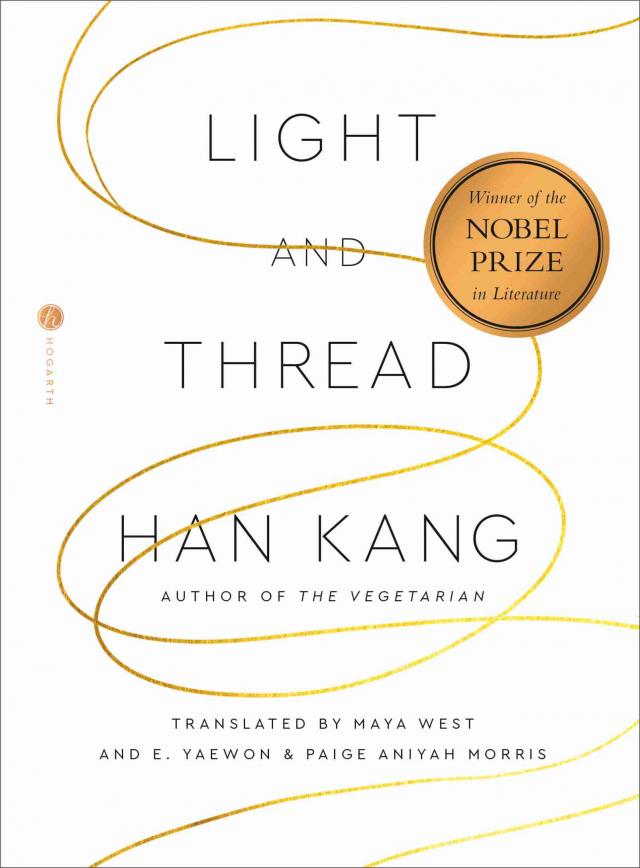
Light and thread, p.1
Light and Thread, page 1


Also by Han Kang
The Vegetarian
Human Acts
The White Book
Greek Lessons
We Do Not Part
Hogarth
An imprint of Random House
A division of Penguin Random House LLC
1745 Broadway, New York, NY 10019
randomhousebooks.com
penguinrandomhouse.com
Translation of “Light and Thread” copyright © 2026 by by e. yaewon and Paige Aniyah Morris
Translation, except as noted, copyright © 2026 by Maya West
Penguin Random House values and supports copyright. Copyright fuels creativity, encourages diverse voices, promotes free speech, and creates a vibrant culture. Thank you for buying an authorized edition of this book and for complying with copyright laws by not reproducing, scanning, or distributing any part of it in any form without permission. You are supporting writers and allowing Penguin Random House to continue to publish books for every reader. Please note that no part of this book may be used or reproduced in any manner for the purpose of training artificial intelligence technologies or systems.
Hogarth is a trademark of the Random House Group Limited, and the H colophon is a trademark of Penguin Random House LLC.
This work was originally published in Korean as 빛과 실, or Bichgwa Sil, by Munhak and Jisungsa Co., Ltd, Seoul, South Korea in 2025, copyright © 2025 by Han Kang. This translation is published in the United Kingdom by Hamish Hamilton, an imprint of Penguin Random House UK, London.
“Light and Thread,” the Nobel Lecture by Han Kang, is copyright © 2024 by The Nobel Foundation and is reprinted by permission.
Hardcover ISBN 9798217155033
Ebook ISBN 9798217155040
book team: Production editor: Jennifer Rodriguez • Managing editor: Rebecca Berlant • Production manager: Linnea Knollmueller • Copy editor: Taylor McGowan • Proofreaders: Claire Maby, Deborah Bader, Amy Brosey
Book design by Susan Turner, adapted for ebook by Vincent Mancuso
Cover design: Cassie Vu
The authorized representative in the EU for product safety and compliance is Penguin Random House Ireland, Morrison Chambers, 32 Nassau Street, Dublin D02 YH68, Ireland. https://eu-contact.penguin.ie
ep_prh_7.3_155411729_c0_r0
Contents
A Note on the Translations
Light and Thread
Even in the Darkest Night
After Publication
Small Teacup
The Coat and I
North-Facing Room
(Meditation on Pain)
Sound(s)
A Very Small Snowflake
North-Facing Garden
Garden Diary
Having Managed to Live Some More
About the Author
About the Translators
_155411729_
A Note on the Translations
The Nobel Lecture “Light and Thread” is translated by e. yaewon and Paige Aniyah Morris. Maya West translated the rest of the book.
Last January, while sorting through my storeroom ahead of an imminent move, I came across an old shoe box. I opened the box to find several diaries dating back to my childhood. Among the stack of journals, there was a pamphlet, the words “A Book of Poems” written in pencil across its front. The booklet was thin: five sheets of rough A5 paper folded in half and bound with staples. I had added two zigzagging lines under the title, one line progressing up in six steps from the left, the other inclining down in seven steps to the right. Was it a kind of cover illustration? Or simply a doodle? The year—1979—and my name were written on the back of the chapbook, with a total of eight poems inscribed on the inner leaves by the same neat, penciled hand as on the front and back covers. Eight different dates marked the bottom of each page in chronological order. The lines penned by my eight-year-old self were suitably innocent and unpolished, but one poem from April caught my eyes. It opened with the following stanzas:
Where is love?
It is inside my thump-thumping beating chest.
What is love?
It is the gold thread connecting between our hearts.
In a flash I was transported back forty years, as memories of that afternoon spent putting the pamphlet together came back to me. My short, stubby pencil with its biro-cap extender, the eraser dust, the big metal stapler I had sneaked out from my father’s room. I remembered how after learning that our family would be moving to Seoul, I had an impulse to gather the poems I had scribbled on slips of paper, or in the margins of notebooks and workbooks, or between journal entries, and collect them into a single volume. I recalled, too, the inexplicable feeling of not wanting to show my “Book of Poems” to anyone once it was completed.
Before placing the diaries and the booklet back as I had found them and closing the lid over them, I took a photo of that poem with my phone. I did this out of a sense that there was a continuity between some of the words I had written then and who I now was. Inside my chest, in my beating heart. Between our hearts. The golden thread that joins—a thread that emanates light.
* * *
Fourteen years later, with the publication of my first poem and then my first short story in the following year, I became a Writer. In another five years, I would publish my first long work of fiction, which I had written over the course of about three years. I was, and remain, intrigued by the process of writing poetry and short stories, but writing novels has a special pull on me. My books have taken me anywhere from a year to seven years to complete, for which I have exchanged considerable portions of my personal life. This is what draws me to the work. The way I can delve into, and dwell in, the questions I feel are imperative and urgent, so much so that I decide to accept the tradeoff.
Each time I work on a novel, I endure the questions, I live inside them. When I reach the end of these questions—which is not the same as when I find answers to them—is when I reach the end of the writing process. By then, I am no longer as I was when I began, and from that changed state, I start again. The next questions follow, like links in a chain, or like dominoes, overlapping and joining and continuing, and I am moved to write something new.
While writing my third novel, The Vegetarian, from 2003 to 2005, I was staying with some painful questions: Can a person ever be completely innocent? To what depths can we reject violence? What happens to one who refuses to belong to the species called human?
Electing not to eat meat in a refusal of violence, and in the end declining all food and drink except water in the belief that she has transformed into a plant, Yeong-hye, the protagonist of The Vegetarian, finds herself in the ironic situation of quickening towards death in her bid to save herself. Yeong-hye and her sister In-hye, who are in fact co-protagonists, scream soundlessly through devastating nightmares and ruptures, but are together in the end. I set the final scene in an ambulance, as I hoped Yeong-hye would remain alive in the world of this story. The car rushes down the mountain road beneath blazing green leaves while the alert older sister gazes intensely out the window. Perhaps awaiting a response, or perhaps in protest. The entire novel resides in a state of questioning. Staring and defying. Waiting for a response.
Ink and Blood, the novel that followed The Vegetarian, continues these questions. To refuse life and the world in order to refuse violence is an impossibility. We cannot, after all, turn into plants. Then how do we continue on? In this mystery novel, sentences in roman and italic type jostle and clash, as the main character, who has long wrestled with death’s shadow, risks her life to prove that her friend’s sudden death cannot have been by suicide. As I wrote the closing scene, as I described her dragging herself across the floor to crawl her way out of death and destruction, I was asking myself these questions: Must we not survive in the end? Should our lives not bear witness to what is true?
With my fifth novel, Greek Lessons, I pushed even further. If we must live on in this world, which moments make that possible? A woman who has lost her speech and a man who is losing his sight are walking through stillness and darkness when their solitary paths cross. I wanted to attend to the tactile moments in this story. The novel progresses at its own slow pace through stillness and darkness to when the woman’s hand reaches out and writes a few words in the man’s palm. In that luminous instant that expands to an eternity, these two characters reveal the softer parts of themselves. The question I wanted to ask here was this: Could it be that by regarding the softest aspects of humanity, by caressing the irrefutable warmth that resides there, we can go on living after all in this brief, violent world?
Having reached the end of this question, I began thinking about my next book. This was in the spring of 2012, not long after Greek Lessons was published. I told myself I would write a novel that takes another step towards light and warmth. I would suffuse this life- and world-embracing work with bright, transparent sensations. I soon found a title and was twenty pages into the first draft, when I was forced to stop.
I realized that something within was preventing me from writing this novel.
* * *
Until then, I hadn’t considered writing about Gwangju.
I was nine years old when my family left Gwangju in January 1980, roughly four months before the mass killings began. When I happened across the upside-down spine of Gwangju Photo Book on a bookshelf a few years later and looked through it when there were no adults around, I was twelve. This book contained photographs of Gwangju residents and students killed with clubs, bayonets, and guns while resisting the new military powers that had orchestrated the coup. Published and distributed in secret by the survivors and the families of the dead, the book bore witness to the truth at a time when the truth was being distorted by strict media suppression. As a child, I hadn’t grasped the political significance of those images, and the ravaged faces became fixed in my mind as a fundamental question about humans: Is this the act of one human towards another? And then, seeing a photo of an endless queue of people waiting to donate blood outside a university hospital: Is this the act of one human towards another? These two questions clashed and seemed irreconcilable, their incompatibility a knot I couldn’t undo.
So that one spring day in 2012, as I tried my hand at writing a radiant, life-affirming novel, I was once again confronted by this unresolved problem. I had long lost a sense of deep-rooted trust in humans. How, then, could I embrace the world? I had to face this impossible conundrum if I meant to move forwards, I realized. I understood that writing was my only means of getting through and past it.
I spent the better part of that year sketching out my novel, imagining that May 1980 in Gwangju would form one layer of the book. In December, I visited the cemetery in Mangwol-dong. It was well past noon and a heavy snow had fallen just the day before. Later, as the light darkened, I walked out of the freezing cemetery with my hand over my chest, close to my heart. I told myself this next novel would look squarely at Gwangju, rather than consigning it to a single layer. I obtained a book containing more than 900 testimonials, and every day for nine hours over the course of a month, I read each account collected there. Then I read up on not just Gwangju but other cases of state violence. Then, looking even further afield and back in time, I read about mass killings that humans have repeatedly perpetrated throughout the world and throughout history.
During this period of researching my novel, two questions were often foremost in my mind. Back in my mid-twenties, I had written these lines on the first page of every new diary:
Can the present help the past?
Can the living save the dead?
As I continued reading, it became clear that these were impossible questions. Through this sustained encounter with the bleakest aspects of humanity, I felt the remnants of my long-fractured belief in humanity shatter entirely. I all but gave up on the novel.
Then I read the diary entries of a young night-school educator. A shy, quiet youth, Park Yong-jun had participated in the “absolute community” of self-governing citizens that formed in Gwangju over the ten-day uprising in May 1980. He was shot and killed in the YWCA building near the provincial administration headquarters where he had chosen to remain, despite knowing that the soldiers would be returning in the early hours. On that last night, he had written in his diary, “Why, God, must I have a conscience that pricks and pains me so? I wish to live.”
Reading these sentences, I knew with the clarity of lightning which way the novel must go. And that my two questions had to be reversed.
Can the past help the present?
Can the dead save the living?
Later, as I was writing what would become Human Acts, I sensed at certain moments that the past was indeed helping the present, and that the dead were saving the living. I would revisit the cemetery from time to time, and somehow the weather would always be clear. I would close my eyes, and the sun’s orange rays would suffuse my lids. I felt it as life’s own light. I felt the light and air envelop me in indescribable warmth.
The questions that remained with me long after I saw that book of photographs were these: How are humans this violent? And yet how is it that they can simultaneously stand opposite such overwhelming violence? What does it mean to belong to the species called human? To negotiate an impossible way through the empty space between these two precipices of human horrors and human dignity, I needed the assistance of the dead. Just as in this novel, Human Acts, the child Dong-ho tugs at his mother’s hand to coax her towards the sun.
Of course, I could not undo what had been done to the dead, to the bereaved, or to the survivors. All I could do was lend them the sensations, emotions, and life pulsing through my own body. Wishing to light a candle at the start and the end of the novel, I set the opening scene in the municipal gymnasium where the bodies of the deceased were housed and the funeral services were held. There, we witness fifteen-year-old Dong-ho laying white sheets over the bodies and lighting candles. Staring into the pale blue heart of each flame.
The Korean title of this novel is Sonyeon-i onda. The last word “onda” is the present tense of the verb “oda,” to come. The moment the sonyeon, the boy, is addressed in the second person as you, whether the intimate or the less intimate you, he awakens in the dim light and walks towards the present. His steps are the steps of a spirit. He draws ever nearer and becomes the now. When a time and place in which human cruelty and dignity existed in extreme parallel is referred to as Gwangju, that name ceases to be a proper noun unique to one city and instead becomes a common noun, as I learned in writing this book. It comes to us—again and again across time and space, and always in the present tense. Even now.
* * *
When the book was finally completed and published in the spring of 2014, I was surprised by the pain that readers confessed to feeling while reading it. I had to take some time to think about how the pain I had felt throughout the writing process and the distress that my readers had expressed to me were connected. What might be behind that anguish? Is it that we want to put our faith in humanity, and when that faith is shaken, we feel as though our very selves are being destroyed? Is it that we want to love humanity, and this is the agony we feel when that love is shattered?
Does love beget pain, and is some pain evidence of love?
That same year in June, I had a dream. A dream in which I was walking across a vast plain as a sparse snow was falling. Thousands upon thousands of black tree stumps dotted the plain, and behind every last one of them was a burial mound. At some point, I was stepping in water, and when I looked back, I saw the ocean rushing in from the edge of the plain, which I had mistaken for the horizon. Why were there graves in a place like this? I wondered. Wouldn’t all the bones in the lower mounds closer to the sea have been swept away? Shouldn’t I at least relocate the bones in the upper mounds, now, before it was too late? But how? I didn’t even have a shovel.
The water was already up to my ankles. I awoke, and as I stared out of the still-dark window, I intuited that this dream was telling me something important. After I wrote the dream down, I recall thinking that this might be the start of my next novel.
I didn’t have a clear idea of where it might lead, however, and found myself starting and scrapping the beginnings of several potential stories I imagined might follow from that dream. Finally, in December 2017, I rented a room on Jeju Island and spent the next two years or so dividing my time between Jeju and Seoul. Walking in the forests, along the sea, and on the village roads, feeling the intense Jeju weather at every moment—its wind and light and snow and rain—I sensed the outline of the novel come into focus. As with Human Acts, I read testimonies from massacre survivors, pored over materials, and then, in as restrained a manner as I could without looking away from the brutal details that felt almost impossible to put into words, I wrote what became We Do Not Part. The book was published nearly seven years after I had dreamed of those black tree stumps, that surging sea.
In the notebook I kept while working on that book, I made these notes:
Life seeks to live. Life is warm.
To die is to grow cold.
To have snow settle over one’s face rather than melt.
To kill is to make cold.
Humans in history and humans in the cosmos.