Skarsnik, p.1
Skarsnik, page 1


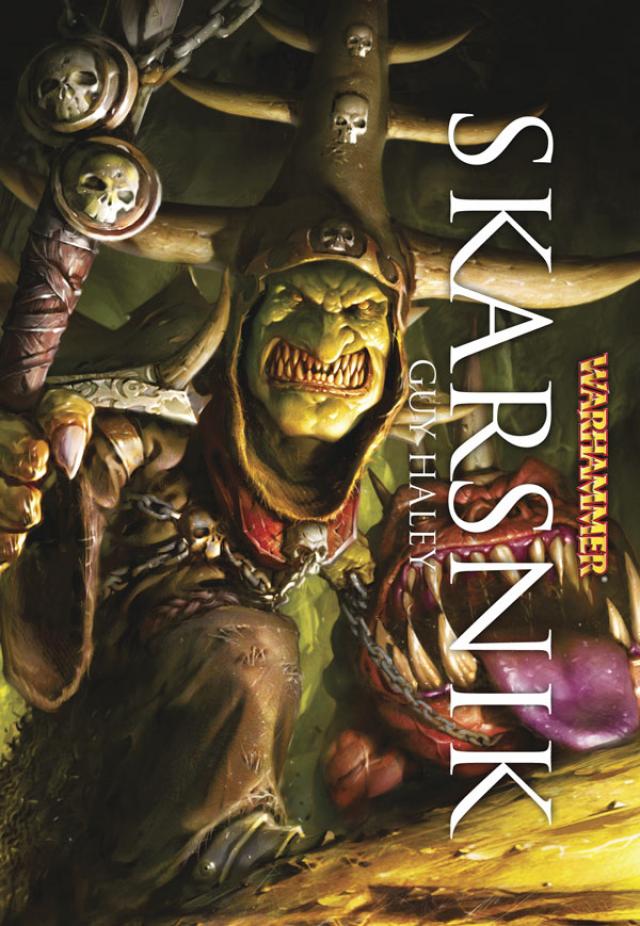
This is a dark age, a bloody age, an age of daemons and of sorcery. It is an age of battle and death, and of the world’s ending. Amidst all of the fire, flame and fury it is a time, too, of mighty heroes, of bold deeds and great courage.
At the heart of the Old World sprawls the Empire, the largest and most powerful of the human realms. Known for its engineers, sorcerers, traders and soldiers, it isa land of great mountains, mighty rivers, dark forestsand vast cities. And from his throne in Altdorf reignsthe Emperor Karl Franz, sacred descendant of thefounder of these lands, Sigmar, and wielder of his magical warhammer.
But these are far from civilised times. Across the length and breadth of the Old World, from the knightly palaces of Bretonnia to ice-bound Kislev in the far north, come rumblings of war. In the towering Worlds Edge Mountains, the orc tribes are gathering for another assault. Bandits and renegades harry the wild southern lands ofthe Border Princes. There are rumours of rat-things, the skaven, emerging from the sewers and swamps across the land. And from the northern wildernesses there is the ever-present threat of Chaos, of daemons and beastmen corrupted by the foul powers of the Dark Gods. As the time of battle draws ever nearer, the Empire needs heroes like never before.
Chapter 1
The Sisters of Mercy
In his carriage, Kaspar Wollendorp shivered. Cold prodded at his flesh with iron fingers. It scraped the inside of his nose with its nails. It dragged his breath from his throat in plumes, tugging it out of the carriage window to merge with the fog blanketing Averheim. Outside, the torches either side of the barrack doors were orbs of yellow, marsh-lights deep in the city. Black shadows of men in the yard slapped at their arms and rubbed their hands round a smear of brazier flame. Dawn was some time away. This was not an hour Wollendorp was accustomed to.
He was well fleshed, Wollendorp, but in weather like this, that only meant there was more of him to freeze. His long cheeks ran off his face to form jowls, giving his face a lugubrious expression. His lips were full and downturned. Together with his hooded eyes, he had a look of sorrowful disapproval to him. Those who were acquainted well with Wollendorp knew he was a kindly man; his face did not match his heart at all, but for once it displayed his emotions accurately.
He blinked. His eyeballs ached with the chill. His hat did little to keep the cold from his bald head. He pulled his chin further into the fur collar of his coat and let out a shuddering groan. His hands found each other within his muff. Touching his own fingers was as pleasant as grabbing ice. This would not do, not at all. He tried to doze. The cold battled his efforts until his thoughts blurred into dreams and he sank into an uneasy place of cold moors and inexplicable noises.
Squealing iron dragged him back to full wakefulness. He leaned forward as the door of the carriage jerked open, nearly banging heads with Captain Aldous Meisen of the Scarlet Blades. The carriage rocked. Sharp clips of hooves on cobbles sounded thinly in the fog.
‘What cursed hour do you call this, Wollendorp?’ growled the captain. He threw himself into his seat. He was a singularly ugly man, huge and bullish with a squashed nose and a scar across his forehead. He was not yet into his thirties, yet already his hair was thinning, and Meisen had taken to wearing it cropped close to his skull to hide the fact. The white roads of old blade wounds were stark on his scalp. A gaudy earring hung from his right ear. His clothes were of rough suede, the red of the Scarlet Blades, and he stank. He stank of beer and cheap Tilean wine and dwarf tobacco and the faded glory of the Blades. ‘I should have stayed abed and let you freeze out here alone.’
Wollendorp was not fond of Meisen. He made little attempt to hide his dislike. ‘He is awake, and he is lucid,’ he said.
‘What of it? Surely the ravings of a madman can no longer be of interest to the city. There is too much to be done here, half the place is in ruins still. Let the aldermen look to their own, not be casting their gaze over the mountains.’
‘Lord Osthammar thinks it worthwhile,’ said Wollendorp. He pulled his left hand from his muff, picked up his cane and banged its brass top on the carriage ceiling. ‘On, driver! On!’
‘Sigmar blast Osthammar,’ grumbled Meisen. ‘Last thing the city needs now is wretched foreign adventure.’
‘Nevertheless, it is he who commissioned us,’ said Wollendorp.
Meisen muttered something unintelligible and spat out of the window.
‘I think you are still drunk, captain.’
The carriage clattered into life, rumbling along Fleischstrasse. The Scarlet Blades, Averheim’s darlings during the time of Countess Ludmilla, had fallen far in the city’s affections. When the Neumarkt had been commissioned in the wake of the city’s recent unrest, to be built back up from the river, the Blades’ barracks had not been relocated, and that spoke volumes as to exactly how far their fall had been. The stink of cattle and slaughter hung about this district now. It did little to mask the malodour of disgrace emanating from the barracks.
With a freezing finger, Wollendorp lifted the leather flap covering the unglazed window. Cranes and the frames of unfinished buildings loomed suddenly out of the dark like grotesque skeletons. Somewhere to the left of them rose the great bulk of the Averburg, invisible in the fog. The lights on the nearest buildings were visible as cottony balls; further away they pulled themselves out into nothing. The fog glowed with the collected flames of Averheim, eerie and illuminating nothingness. The fog pressed hard around the carriage, and Wollendorp had the uncomfortable feeling they were travelling a sorcerous road, condemned to ride it forever. A shiver ran up his spine. He’d always had too much imagination.
In truth he found it hard to argue with Meisen, this was a waste of time. The man in the asylum, Bickenstadt, had been raving for months. Two years since their employment, and Wollendorp’s initial enthusiasm for Osthammar’s project had waned; he was bored and impatient to get back to his own studies. At the least, this meeting should be the end of it. His report was nearly done.
A cry of ‘Ware!’ went up. The carriage slowed. They were approaching the Geisttor. There was some conversation as the driver handed over Osthammar’s letter of patronage to the Averguard. Passage through the city walls at this time of night was not easily achieved. There was a slight delay, the Geisttor creaked open and the carriage clattered on.
Brickwork passed by inches away. Geisttor was one of the smaller gates bored through the thick city walls. Then they were out, back into the fog. Wollendorp looked up but could not see the tops of the walls, only that diffuse, horrible light. Nor could he see the moons, which was for once a small mercy. Morrslieb would be approaching full, and Wollendorp was glad it could not see him more than he was glad he could not see it.
They passed the ward, that broad zone outside the walls kept free of buildings, and then were into the outer city. Narrow lanes and alleyways led off the highway into warrens of timbered housing, all dead ends tonight, stoppered by the fog. A man stared at Wollendorp as the carriage passed, causing the academic to shift in his seat uncomfortably.
Streets gave way to scattered buildings, then to farms. The fog became a wall of grey, lit only by the carriage lamps. The road leading out from Geisttor became little better than a track. It was too early for the farmers who used it to be making their way in to market. The road was empty.
Of human traffic, at least.
Above Wollendorp’s head came a pair of clicks as his footman and driver pulled back the hammers on their blunderbusses. Even this close to the city, it paid to be careful.
Meisen snored opposite him.
He sat lost in thought for an hour or so, until the way grew less smooth, the track rutted. The cab swayed on its leather straps. Despite the lurch and bang of potholes, despite his mind going over what might be out there in the fog, Wollendorp was lulled to sleep by the creak of the carriage.
Once, he had loved travelling by carriage for that soporific song of wood and leather, but that had been a long time ago.
‘Herr doktor! Herr doktor!’ A hand was shaking him gently. Wollendorp awoke with a start.
‘Herr doktor? Are you awake?’
‘Dieter? Yes, yes, I am awake.’
Wollendorp’s footman bobbed a bow. ‘We have arrived, herr doktor.’
Wollendorp squinted past Dieter. It was growing light. His joints cracked as he pulled himself out of the carriage. The footman moved to support him. He waved the hand away. ‘I am growing older, but I am not yet old, Dieter.’
‘Yes, herr doktor.’ Dieter moved aside, and Wollendorp stepped out.
The carriage was in the bailey of a castle. A stable boy aided Wollendorp’s two footmen and driver in unhitching the horses and stripping them of their gear. Another gathered the tack, looping it neatly about his arms, and took it away to be oiled. The carriage, noted Wollendorp with annoyance, was filthy with mud.
He took in his surroundings. It was early morning. The fog had gone, clinging on only as wisps here and there. The sky was a flat white, the sun an irrelevant circle behind it. The cold lingered.
The castle was arranged at the summit of a knoll. To the north-east, where the curtain wall dipped down, Wollendorp could see into a sparse wood of pine and, beyond that, the flat plains of the province, thick with grain. The rolling nature of the land accentuated the modest height of the castle’s perch. The keep, a long lozenge-shaped affair, stood on the highest point of this promontory of rock. The castle was a compromise between luxury and military consideration. It h ad many decorative turrets. Blue slate tiles clad its roof in a diamond lay. An ornate lantern window crowned the octagonal roof, a bronze of Sigmar’s comet at its apex.
These days the luxury was fading, and the keep served to keep people in, not out. The windows sported heavy iron bars, rust from them streaking the fine ashlar. Stone additions to the buildings were obvious by their lighter colour. All were the badges of Shallya – hearts and doves – and before the keep’s main entrance was a small garden with a statue of a woman: Shallya herself, mother of mercy. Her face smiled and her hands were held out in blessing, stone tears on her stone cheeks.
He felt eyes on him, and looked to a wide oriel window on the first floor. Wan faces peered back: the inmates. After a lifetime of study, Wollendorp’s eyes were no longer good, and he could not pick out their individual features. Each was an identical ghost, dressed in white. They stared at him sadly until a stout female figure waved them back.
Wollendorp turned from them with a shudder.
Meisen stood by the stables, urinating upon a pile of dung and straw. He was staring upwards at the white sky, a cloud of his own steam wreathing him. He glanced back.
‘You’re awake.’
‘I am.’
‘Nice defensible spot,’ said Meisen. He hitched himself up and shook his shoulders. He did not pause to adjust himself, refastening his codpiece strings even as he walked to join Wollendorp. ‘Good wheat lands, good horse country too, down there.’ He pointed his chin down the hill.
‘Schloss Werdentraum was gifted to the order by the Alptraums seventy years ago,’ said Wollendorp. ‘I believe they still own the estate.’
‘And now it is a madhouse? Such a waste.’
‘Seeing as you know little of it, I doubt it had much military significance, and they are much blessed with large houses,’ he said drily. ‘Ah, here comes our welcoming committee.’
A dumpy priestess of Shallya passed through the keep’s double doors and came down the steps to the garden. She was one of those waistless women, all hip and bosom, whose form seem ill-suited to movement, but who nevertheless move with the bustle of those with a great many things to do and a low tolerance for those who would interrupt them. She puffed as she walked, cheeks red in the harsh morning air. A large bunch of keys chinked at her side.
‘Herr Doktor Wollendorp?’
Wollendorp put out his hands and dipped his head in a courtly bow. ‘It is I. Thank you for your message, blessed mother.’
‘Oh, no need for all that,’ she flapped a chapped hand. ‘I’m a lay sister, a nurse. The priests and priestesses have rather too much on their hands to receive visitors,’ she said, the subtext ‘as have I,’ stamped all over on her soft face. ‘Morrslieb waxes full two days hence, a busy time for us.’ She looked them up and down disapprovingly. ‘I am Sister Tabatha. And, there are two of you.’
Wollendorp gave a weak smile. ‘I am sorry for the inconvenience. I promise we will be brief and silent in our investigation.’
‘We? Your instructions said nothing about “we”,’ she huffed.
‘May I present Captain Meisen of the Averheim Scarlet Blades?’
‘Are they still clinging on?’ she said. Whatever merits Sister Tabatha might possess as a madhouse warden, tact was not among them.
‘The scandal did not quite finish us off, sister,’ said Meisen. ‘There are a few of us left who desire to restore our regiment’s honour.’ He held out his hand to take the sister’s in his own to kiss it. She looked at him as if he were mad and pulled it back.
‘I will see to it that your servants are fed. This way, please,’ she said, and turned on her heel.
The schloss was the picture of faded glories. Tapestries hung on the walls, yet they were dirty and torn. The windows held a small fortune’s worth of glass, but were smeared, and carpets were upon the floor, but threadbare. Lunatics wandered the halls freely. Some stared, some cowered, one hissed something at them in a tongue intelligible only to himself, another held spastic hands before her face and leered at them most horribly.
‘Do not fear them. They are, for the main part, harmless,’ said Sister Tabatha.
‘I do not fear them,’ replied Wollendorp.
‘Then why do you recoil, herr doktor?’ said Meisen. Wollendorp found the man’s swaggering most disagreeable. He jumped almost as much as the shuffling lunatics when Meisen made to scare them.
‘I cannot help it. We men keep our place and life by dint of reason shackled to the cart of our efforts. Without reason we are nothing. To see a man bereft of reason is one of the greatest tragedies this cruel world has to offer.’
A lunatic shrieked as Meisen pulled a face at her.
‘Oh, do stop that, Meisen!’
‘As you wish.’
‘Thank you, herr doktor,’ said Tabatha under her breath.
‘Meisen is an uncouth man,’ said Wollendorp loudly. ‘I can only apologise on his behalf.’
They passed into a broad hall, the one with the window Wollendorp had seen from the courtyard. Trestle tables were set up in rows and the afflicted sat there, quiet, loud, weeping, laughing – a carnival of human emotion, unfettered by custom or sanity.
Wollendorp found it all too tragic and looked out of the window. The view was quite astonishing, endless miles of golden wheat and horse farms, the broad bands of the River Aver coiled carelessly across the land in the distance.
‘You must have money to stay here,’ said Meisen. ‘I’ve seen a few madhouses in my time. Not like this at all.’
Probably as an inmate, thought Wollendorp, but he was too much of a gentleman to say so.
‘It is true,’ said Sister Tabatha. She reached another door, unhitched her keys and turned them around their iron ring until she found the one she required. ‘Our wards’ relatives give generously. Many here are the scions of noble and merchant families. A proportion of our income goes to the poorer houses the order runs in Averheim, but still… inequity was ever the way of the world.’ She looked at Wollendorp as if he were the source of said inequity. ‘Madness unites those we treat. All are equal before the mercy of the mother.’
A young man with drooping hair and huge eyes pawed at Wollendorp. ‘Oh, kind sir, kind, kind sir, please, I beg aid of you. You see,’ he looked from side to side, ‘I’m not mad,’ he said in a stage whisper.
‘Away with you, Maximillian!’ Tabatha said. A glance motivated two lounging orderlies, huge, unfriendly men, to move the boy away.
‘No, no, no! Please sir, please! I am not a madman, I am sane! I have seen them! I see them! Green things! Green in the night! Why will you not listen?’ The boy’s words choked off into sobs as he was hauled backwards.
‘I urge you to be careful, gentlemen. We are entering our secure section. Those confined within are less biddable than the inmates you have thus far seen. Are you ready?’
‘Yes, yes,’ said Wollendorp and waved an impatient hand. Meisen sneered at his nerves, much to Wollendorp’s annoyance.
On the other side of the door sat a desk, and behind the desk sat a man with an avian face, lank hair as black as raven feathers, and button eyes of similar hue.
‘I must leave you here. Krest will show you to Bickenstadt’s accommodation.’
Tabatha returned through the door without acknowledging Wollendorp’s thanks.
Krest smiled warmly, belying the hardness of his features. ‘Come to see our playwright, have you, sirs?’
Wollendorp indicated that this was so.
Krest took up a bunch of keys even larger than that carried by Sister Tabatha. He stuck his head into a doorway and instructed someone within to man the desk. ‘This way, gentlemen.’ He led them down a long corridor, the drawing rooms, libraries, and ballrooms of the old schloss converted into quarters for the inmates. Heavy doors occupied each doorway, a barred window allowing the warders to look within. ‘Stay away from the doors, do not answer the inmates, do not give them anything.’ He gave them a reassuring look. ‘Best ignore them altogether, if I was you. Leave them to us, eh, sirs?’
‘Of course.’
Krest took a turn into a side corridor, and brought them to a narrow servant’s staircase. ‘Might I inquire as to what your interest is in Herr Bickenstadt?’