

Nameless, p.1
Nameless, page 1


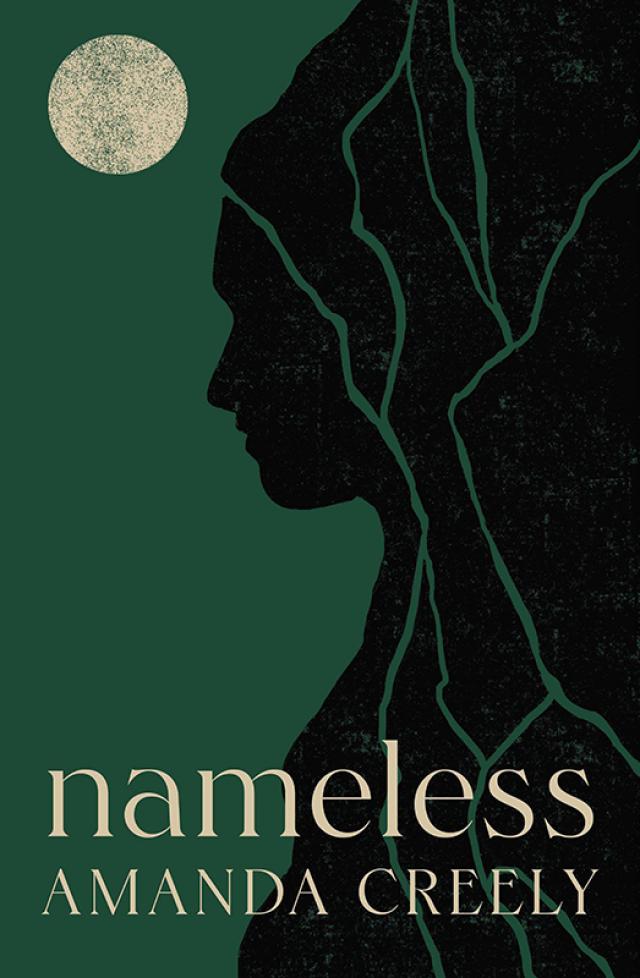
nameless
ABOUT THE AUTHOR
Amanda Creely is an Australian writer from Bendigo, Victoria and holds a Bachelor of Arts in Writing and Literature. Amanda has previously worked as a librarian and a nurse. Of Irish descent, stories have always played a large part in Amanda’s life – she started writing her own as a child and has never stopped.
nameless
AMANDA CREELY
For Mum and Dad… thank you.
First published in 2024 by
UWA Publishing
Crawley, Western Australia 6009
www.uwap.uwa.edu.au
UWAP is an imprint of UWA Publishing
a division of The University of Western Australia
This book is copyright. Apart from any fair dealing for the purpose of private study, research, criticism or review, as permitted under the Copyright Act 1968, no part may be reproduced by any process without written permission. Enquiries should be made to the publisher.
Copyright © Amanda Creely 2024.
The moral right of the author has been asserted.
ISBN: 978-1-76080-273-8
Cover design by Mika Tabata
Typeset in 12 point Dante by Lasertype
Printed by McPherson’s Printing Group
Part I
1
MY HUSBAND DIED today. My daughter too. And my sons.
I say it easily, don’t I? Just words spoken in a normal voice. Not screamed or wept or whispered.
Not bled.
I say it as if they were people I didn’t know. Just faces on a street. But I did know them. I knew them. And now they’re dead.
Dead.
Gone.
Now they exist only in my memory. In an epitaph written across my mind. A shrine for people who once had life, who walked and talked and laughed and loved.
Laughed so much.
Loved so much.
Dead. All dead.
I am in shock. I am numb. Maybe I’m dead too and don’t realise. Maybe my body lies next to theirs on our street, with a bullet in my brain. But it doesn’t. I am alive and so is Daughter. Because of Eldest.
Eldest. Remember her. Please.
There’s another name that will be remembered. One I want to forget. I want to tear the tongue from the mouth of anyone who says it. To strike it from every page of every book that will ever be written. From the earth. I want to kill its bearer and grind his evil fucking face beneath the heel of my boot until not even a drop of his blood remains for God to find.
Murderer. Rapist. Evil. Evil. Evil.
He was the Invader. His army was a Pack. They swarmed across our land and laid siege to our city at summer’s end. Many of us fled, many stayed, hoping, praying we were strong enough. For months they assaulted us; for months they died and so did we. The city had never fallen, and though the Pack was a massive force it surely would not fall now.
But we were losing. Our Leader knew that. The Invader offered us safety in return for surrender. Our Leader agreed and our army laid down its weapons.
The Pack stormed the city with the Invader at their fore. They killed everyone in their path. Soldiers, women, men. Babies. Tossed like dolls on bayonets. Tossed to shatter on the earth.
The Invader broke his word. What did we expect? We shouldn’t have been so stupid. Shouldn’t have been so stupid as to trust such evil.
No mercy. That was what he said.
No mercy. That was the entirety of his heart.
The Pack murdered our Leader and his wife and young children with a juddering stream of bullets that mutilated our place of government with their violence. Marked the walls with blood.
Then the Invader turned his back on the dead as if they were just carrion. No words of honour came from his lips and I doubted any touched his thoughts. What would such a man know of honour?
Day by day he led the Pack through district after district. No one knew when or where they would strike next, who should flee, who should stay, would our army stop them in time. We lived on the outskirts of the city, a short distance behind the lines, near parkland and woods that accommodated a makeshift tent hospital.
On the air the smell of garlic. Of lamb and onions and steaming bowls carried in careful hands. Carried then dropped onto ground wet with blood. Smashed. Like the spirit of our people.
They told us we’d be protected. That hospitals were respected by the enemy.
We heard the Pack coming. Heard the gunfire. The screams. We were warned. But not soon enough to escape. Because the Pack was an immense wave that flowed too fast for escape. The gunfire and screams from nearby streets came only moments before they were at our door.
The Invader liked to kill. That was why he led his army personally. He wanted the people he vanquished to see his face and know his might. He wanted them to fear him. To call him God.
Devil.
He walked along footpaths and through parks and shot men and women and children and grandparents and friends and neighbours and lovers, and they lay dead beneath statues celebrating our history. Bullet holes in their backs. In their legs. Cut down as they tried to escape. To be free. To be safe.
He got off on that. On the terror. The death. On the power.
The Invader killed Husband first. Then Son and Youngest, smiling at their screams and tears. Patting my cheek in sympathetic parody while his soldiers held me. Held me so I didn’t fall. So I didn’t tear his fucking eyes out.
My husband. My boys. My heart torn into shreds.
The Invader stepped over their bodies and put the gun to Daughter’s head. His finger moved on the trigger and Daughter sobbed, awful, tearing sobs that ripped at her throat. Terrified, so, so terrified.
Save me, Mother. Please save me. I don’t want to die. I’m scared. You are my mother and I need you to protect me.
Yet I couldn’t. I was too weak. They held me and their hands were like steel and all I could do was weep.
No, no, no, don’t, please don’t…oh, God, God…it’s not real, it’s not real.
But Eldest was stronger than me. Like a Fury from a dark myth she pulled free and attacked the soldiers, all rage and hate and fire. She grabbed a gun. Wrested it from the man with her teeth bared. Turned and pulled the trigger and sent a stream of flesh-eating barbs into the group of murderers. Another. Killing. Wounding. At least a dozen.
She turned to the Invader. Aimed. And he hid behind his soldiers.
Fucking coward.
But Eldest was seized and the gun was struck from her hands and the bullets meant to kill that coward showered the empty sky instead. She was seized and subdued but she’d distracted the Invader from his deadly game. His slaughter was momentarily forgotten and his attention focused only on her.
Her beauty. Her fearlessness. Her defiance on pink lips and white face and in the hate that spat like venom from her eyes.
The Invader’s lust was all too clear.
He bowed in mock courtesy. His eyes gleamed with a sardonic smile. That smile turned my blood to ice.
Men like him are aroused by fear and hate. They want to crush it.
What is worse for a woman than death? He knew.
The Invader punished Eldest for being strong. He punished her for being a woman. He did things to her…allowed his men to do things to her…things I won’t even whisper.
Things I can’t even whisper.
I am her mother. I should have protected her. But I did not.
Then he beat Eldest until her body gave up. He scorned her and ridiculed her. He watched her die.
I watched her die.
I watched.
Her die.
I don’t have any words to describe how it felt seeing that. Perhaps one day I will. But not today. Today I barely know my own name. Because I am no longer that person. That person is also dead.
Instead I am Teller. Narrator of the tale. Mother to Daughter. Now my only child. And I must protect her.
Forgive me. As you can tell, my story isn’t a nice one, and I wouldn’t blame you if you gave up on it. But I’ll keep going, and if you want to hear it, stay with me. Because nice or terrifying, it has to be told. So you know. So no one forgets. Because people forget so easily. It’s how we’re made, and if we weren’t, life would stop and we’d sit in our filth and rot, too scared to move because of all the bad memories we can’t let go of.
What happened then is a jumble. The Pack turned at shouts from nearby streets. Gunfire. They ran towards it, but there was no need, for it came to them. Some people had mounted a small resistance. Too small. How could they resist so many? But in their actions was honour, and though they died they proved themselves greater than the men they fought so futilely against.
They saved our lives.
Because in the confusion Daughter and I were able to escape. While the Invader barked orders and the Pack quelled the uprising with their chattering-teeth guns.
We ran.
Hand in hand.
Looking back only once.
We left our loved ones behind and had to deal with the guilt of that.
But they were dead. We had watched life abandon bodies too frail to safeguard their spirits.
Husband’s mother should have come with us but she wouldn’t. She ran to her son, her grandchildren. Crying their names over and over and tearing at her grey hair and beating her breast.
Couldn’t she see they were dead? Couldn’t you see that, Grandmother?
They died in her own blood and bile and salt tears on the street before the home they thought a haven. Beneath the cold autumn sun whose muted glow washed their faces the gold of angels.
Broken. Violated. Alone.
Killed by the Invader. Deserted by us. Deserted by me.
Now Daughter and I stood within dense trees near the top of a small crag before a wall of crumbling stone with a man we didn’t know.
Rescuer.
Rescuer was from the city. He said that he and others were going to resist the Invader and his Pack. A people’s army. They’d been planning and building numbers and would be ready soon. It was just a matter of time.
Words. Just words built on hope that was recklessly placed. Hadn’t he seen the might of what they had to resist?
Impossible.
Rescuer found me and Daughter as we escaped and took us from the city. Half the night we traversed the forest surrounding our home. Exhausted. Barely speaking. Not questioning our destination. Just wanting to be safe.
Like an expert, Rescuer avoided soldiers and roads and villages until we reached a lake bordered by dense trees. A lake I knew. I had visited it many times on days full of happiness. Full of innocence.
Boat Hire said a faded sign hung on the wall of a tumbledown shack whose window announced that we could have Ice Creams for a coin.
But there would be no more ice creams lapped at by eager tongues. No boats hired by mothers and fathers to occupy children. By lovers in search of a secluded cove to twine in impatient arms.
Rescuer hurried us into the only one left of those abandoned boats and we crossed a narrow stretch of water to an island.
He called it Sanctuary.
A heavily wooded island hidden within a cluster of wooded islands. One among many.
One lost to the eyes of others among the crowd.
Rescuer told us we would be safe there. He said the people’s army used it as a base from which to plan their resistance to the Invader. Ordinary men and women with one purpose: to fight back.
But would we be safe? Was anywhere safe anymore?
I turned to look at my home on the other side of the water. Looked through the trees and light falling rain that dappled the dense carpet of autumn leaves that had fallen before their time.
On the lake was the whisper of past laughter.
Of splashes and paddles and hired boats cutting through water gleaming like silver.
Of ice cream and stolen sugar kisses.
And far away were my children. My husband. Lying dead on a street where once we’d made a home and lived our lives thinking we were safe.
The dawn was still hours away. Hours till it pushed aside night’s darkness to bring its blessed light.
But no amount of light could stop the sound of artillery fire that filled the distant air as the Pack fed on the people like crows on carrion. While they stole the city, the country. While they stole our freedom with their darkness as black as pitch.
While they stole the laughter. The love. The innocence.
That was what lay across the stretch of water between our home and our refuge. A stretch of water to stop an army.
A stretch of water that stopped us going home.
Now… Now we were just the nameless lost to war.
2
I REMEMBER THE faces of the women the most. Fires flaring red behind them. Red like the symbol on the tanks. Red like the explosions from their guns.
But the women’s faces were grey like the sky above. Like the cold rain that slid down their skin. Desperate faces. Hungry faces. The people were starving and the women grieved, because women are nurturers and providers and when their children cry out that they are hungry it cuts their hearts in two.
I knew that.
Because my own children cried.
And although my husband said that it wasn’t our Leader’s fault, I kept thinking that maybe it was.
The world had always argued. Who owns this country or that country or this bit of land or that bit of land as opposed to who wants it as opposed to who has the power to just take it.
It had always happened.
And when countries argued, governments made choices without considering the everyday person. Without considering how they might suffer. As usual, they forgot it was their job to look after their people.
Not kill them.
And though I wouldn’t say it to Husband, I don’t think our Leader made the best decisions when the time came. He was a kind man. A good man. But perhaps a little out of touch with reality, and maybe his lack of action unwittingly set the stage for the Invader’s attack.
The people were hungry. Cold. Sick. Too tired to fight. The country was barely holding it together.
There were reasons. There are always reasons.
But reasons and blame and finger-pointing come at the end of the crisis. If the crisis ends.
If there is a finger left to point.
When the Invader came we tried to resist, but ultimately failed.
And maybe, when it all boiled down, that was our Leader’s fault.
Maybe, maybe, maybe.
Who really knows?
Whatever the case, he paid for it. As did his family. Paid the greatest price. And now he is lost. Everything is lost.
Have you ever heard of Fyodor Dostoevsky? He was an author, and some would say a wise man, if a little morbid at times. He said lots of sensible things, probably did them as well. I don’t know because he died before I was born. I do know his country’s ruler feared him. Or mostly feared the power of his words. So he exiled him for four years to work in a mine. To ensure Dostoevsky knew not to speak against the Crown.
Anyway, something Dostoevsky said came to me as Rescuer led us through the forest, past burned houses, away from the macabre music of distant artillery fire, to Sanctuary. I would have liked to scream it because right now I wanted to scream. Scream out the words so everyone could hear and understand how I was falling apart.
But I couldn’t scream out my grief. I’ve never been able to. Some people can. They wail and moan and rage at the world, and it probably helps. Stops it from boiling up inside and taking their sense.
But not me. I just hold it in. I whisper it.
I am Mother. I must be strong. For my children.
But I think there’s sometimes more emotion in a whisper. It doesn’t cause a fuss. It stays out of the way. Small quiet words that fit into the space of a single heart. Fit into my heart. Held inside where no one can see, and just as full of grief as screaming.
So here’s my bit of Dostoevsky for the day. A whisper of what’s inside me. Maybe a whisper of what was also inside the women on the streets. For on those hungry days, searching for money to buy food made scarce by poor choices, the words certainly prowled the edges of my heart.
‘To live without hope is to cease to live.’
Our family died today.
Our world died today.
Our hope died today.
To live without hope is to cease to live.
Daughter and I died today too.
3
WE CLIMBED a steep hill shrouded with trees until we reached a crumbling wall. Rescuer pushed open a heavy gate and stepped through. But I stopped and barred Daughter’s path. He expected us to trust him, just like that. To go with him, no questions asked.
But I had never trusted anyone I’d just met. Not with something so important. Not with my life. Not with my only daughter’s life. We’d both seen how easily life could be taken.
‘There’s no other way.’ Rescuer’s hand waited on the gate.
I glanced at the city again. Through the trees that enclosed the hill I could see fire. Flaring high in the distance.
I thought of my husband and children and wondered how my heart could still beat lying dead in my chest.
It wasn’t about trust but necessity. Daughter and I were now fugitives. We couldn’t go home; while we lived we had to go on. Even if we didn’t want to.
We stepped through the gate and Rescuer closed it. Bang!
He bolted it. Bang!
Like a gunshot in the silence and I jerked as if struck as reality slapped me in the face. What am I going to do?
My children were dead. My husband was dead. They were gone and there was only Daughter and all I could do was breathe. In. Out. Step. Walk. Keep on. Live for her while they died. Nurture her. Protect her.
Hard, so hard.






