

The silent period, p.1
The Silent Period, page 1
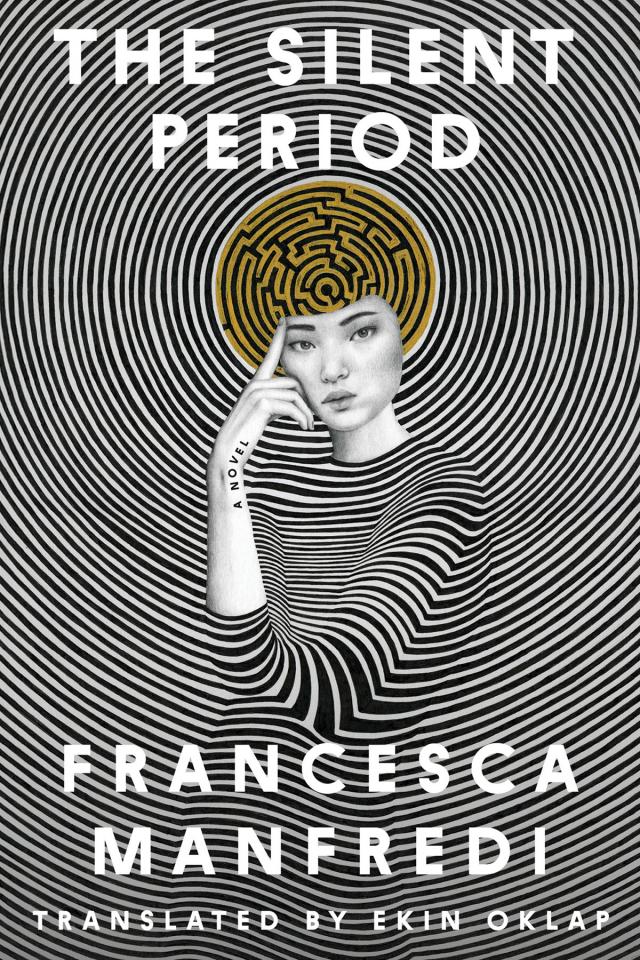


The Silent Period
A NOVEL
Francesca Manfredi
Translated by Ekin Oklap
Contents
Part One C. Reptiles
September
October
November
December
Still December
January
February
Gills
March
April
May
Still May
June
July
Acts
August
Part Two E. Propagation
Evangelization
Elevation
Acknowledgments
Part One
C.
If you want to make people pay attention to what you’re saying, you don’t raise your voice but lower it.
—julian barnes, The Sense of an Ending
* * *
Beckett: I speak of an art turning from [the plane of the feasible] in disgust, weary of puny exploits, weary of pretending to be able, of being able, of doing a little better the same old thing, of going a little further along a dreary road.
Duthuit: And preferring what?
Beckett: The expression that there is nothing to express, nothing with which to express, nothing from which to express, no power to express, no desire to express, together with the obligation to express.
—samuel beckett, Three Dialogues
Reptiles
I once read—I don’t even remember where—a rather stupid statistic on suicides. The research method was not explained, though I suppose it must have focused on failed attempts. Five percent of the people interviewed claimed there had not been any premeditation in their case, nor what might be termed a fit of madness. No major depressive disorder, at least not clinically diagnosed, no panic or anxiety attacks, no to the question on any recent history of traumatic relationship breakdown, no bereavements, no, no, no. Five percent of the respondents—not that small a proportion, when you think about it—admitted that the decision to take their own lives had stemmed from a sudden realization, a momentary epiphany. The gleaming knife that suddenly looks better against your skin than it does on the loaf of bread. The bathtub, and a razor blade resting on its rim. A beam to hang a rope from, and from the rope, your neck. Images that infect the mind with what appears, in the moment, as a promise of purity and perfection.
I have never attempted suicide—I’ve always lacked the motive, more than the will—but I think I know what those people must have meant.
* * *
I decided to cut off all communication around eleven o’clock one evening in September. It seemed nothing remarkable at the time. Isn’t that how everything important starts off?
I was sitting on the sofa between my parents, and The Siege was on TV. My mother was the only one watching the film. My father was reading yesterday’s newspaper, glancing up every now and then whenever the volume rose with the sound of shooting or explosions. I had just come home from an evening out at the Quadrilatero neighborhood, where I had drunk two oversweet and overpriced cocktails, eaten substandard food, and spent the whole time wishing I were at home instead. I noticed I was staring at the wall next to the television, and thought it was a good time as any to go to bed. My mother was sitting with her eyes fixed on the screen and her torso tilted forward, not touching the back of the sofa; I kissed her on the cheek, then my father too, got up, went to my room. I sat on my bed and started scrolling my Instagram feed. My eyes were burning, the screen was on the lowest brightness setting, and everything looked blurry. I stared at a photograph of a French influencer on the beach; she had a tropical flower tucked behind her ear, and the stigma was like some kind of bait that—if looked at for too long—would suck the spectator into the corolla and imprison them in a hollow, bottomless void.
I opened the home screen and held my finger on the app I had just closed. Remove “Instagram”? Removing from Home Screen will keep the app in your App Library. I selected Delete App. Delete “Instagram”? Deleting this app will also delete its data. Delete. The icon vanished. I switched my phone off and got into bed. I fell asleep immediately and dreamt I was a reptile.
September
There isn’t much to say about me. At least there didn’t use to be. There would be now, but it’s not something I want to do. Back when it all began, I was twenty-eight and still living with my parents. I had just graduated for the second time, a degree in cultural heritage studies followed by a postgraduate degree in archaeology and ancient history, with a dissertation on Latin epigraphy in North Africa. I was working at my local public library in the neighborhood of Santa Rita. It wasn’t a permanent position; I’d gotten it through the state-run voluntary service program I had applied for, and I earned four hundred and fifty euros a month—not enough to live by myself. In my spare time I browsed websites for antiques and vintage items. I hadn’t managed to find any kind of employment related to what I had studied, apart from a couple of internships on construction sites. I’d decided to study archaeology because as a child I had been obsessed with Indiana Jones and I wanted to dig for ancient artifacts. All children born between the late seventies and early nineties will inevitably have experienced an obsession with Indiana Jones, but at some point it tends to pass. Yet even when I was eighteen, my dream was still to get lost somewhere in Nicaragua and stumble upon a lost civilization, which is the shared dream of every first-semester archaeology major. By the second semester, you find out that your chances of ending up in Nicaragua or working on research digs are generally fairly slim, and all of a sudden, everything you’ve been doing seems useless and puerile.
The archaeologists I know mostly work in preventive archaeology. They watch over construction sites and street repairs, sewage systems and cable tunnels, working either as freelancers or on short-term contracts, and always for a pittance. Their presence is necessary because this is Italy and, as everyone knows, as soon as you start digging a road in Italy, some ancient ruin will pop out. This is a small and vertical country, with centuries of rewrites on the same notebook: dig a little and you’ll find something you weren’t expecting. This so-called cultural heritage is in fact a heap of dead rocks, in such excess that nobody honors them properly, and consequently nobody is able to really cherish them either. What the whole world looks upon in wonder is, to us, something of an old nag, cumbersome, costly, unproductive. That’s what the supervisor used to say at the site where I did my compulsory apprenticeship as a university student. He was from Cuneo, in Piedmont, and all his e’s were nasal, his o’s tight. It was strange to hear him among all the other workers—from Calabria, from Romania, from the Maghreb, their accents so concrete and vigorous. His speech was like something fragile and wilting, a Mimosa pudica of phonology, a fossil that would soon be surpassed and covered up, absorbed into the subsoil.
After the apprenticeship it was time for my final oral examination, which I took more or less in secret on one of the hottest days of the year. I went back home to share the news—I’d graduated with full marks but no distinction—and, to save myself from my sister’s and my parents’ protests, I told them: the university’s air-conditioning system doesn’t work; you should be thanking me for having spared you the ordeal. It was no use, and my mother asked me if that was really the outfit I’d shown up in. I was wearing black Bermuda shorts, a Lacoste polo shirt, and a pair of canvas Superga shoes. The shoes were clean. I felt perfectly at ease.
Graduation was followed by a whole host of fruitless job applications and some further unpaid internships, except that one time when a foundation with headquarters fifty kilometers from Turin offered me a three-month contract in exchange for expenses and a museum card. I already had one of those. I gave theirs to my sister.
My sister, Elena, is five years older than me. She has a degree in economics and works for a bank: this means a guaranteed salary, sick leave, holidays, end-of-year bonuses, and everything else I’ll never have. I have never considered security to be important, but once you begin to understand that the true meaning of “do what you love and you’ll never work a day in your life” is that you’ll never be able to live off what you’re passionate about, that’s when you start to feel the absence of something. Though it’s not really an absence; it’s more like a persistent sensation, an inner voice, an awareness whose origin is difficult to locate—in the pit of the stomach, perhaps, like that lethargic feeling after a meal, or maybe more in the bones or in the epithelial tissue—that keeps telling you again and again that you will never be like other people. Maybe it’s just envy for something that’s been closed off to you. Every now and then you think about it and ask yourself where you went wrong, if there was a particular moment. If at some point, at a fork in the road, you took the turn less suitable (every time I’m faced with a decision, my mind goes straight to Pocahontas, tortuous river versus smooth and steady waters), if in fact you took more than one wrong turn, or if it’s just something in your DNA, some recessive gene that’s been lying dormant for years until you lost the game of genetic Russian roulette, your defeat condemning you to a lifetime of ineptitude and unhappiness.
Anyway, at least Elena makes my parents happy, even though they try their best not to let on. When we were little, I was sure things would go a different way. She was the one who always fussed over her food, while I was the chubby little girl everyone complimented on her insatiable appetite—the kind of appetite that encouraged every adult, particu larly of the female sex, to attempt to placate it. What a wonderful time that was: fed by all into a stupor, postprandial torpor as an existential condition, whole days spent between the high chair and the crib and being congratulated for executing the most ordinary bodily functions. No guilt, no trace of restlessness to accompany the inertia—on the contrary, a sense of pride. Now Elena has a duplex in suburban Turin, a husband who helps her with the household chores every weekend, a three-year-old son who still cries if she strays too far, and, I’m sure, a future baby girl who will soon be on the way. Because people like Elena always have a boy and a girl.
After deleting the Instagram app from my phone, I deleted my profile too, then did the same with Facebook, Twitter, LinkedIn, and TikTok. I permanently erased my presence from the social networks I had subscribed to and emptied my phone of all photographs and unused apps. I left any WhatsApp groups I was no longer or not sufficiently involved in, and deleted the chat logs. I did all this in about ten minutes while sitting on the sofa eating paprika-flavored chips. With one hand I picked chips out of the bag, and with the other I deleted profiles. It was a relief to return to the social networks’ log-in pages, where they try to persuade you to join them by showing you how to sign up. A simple request for data, as sterile as an operating theater but decked out in garish colors.
Afterward I smoked a cigarette on the balcony and tried to work out how long it would take for Silvia to notice. We used social media to exchange funny videos or alert each other whenever anyone we detested made a fool of themselves on their profile. Silvia had forty-six thousand followers on her account, which she publicly and regularly threatened to delete. This usually happened when she voiced an opinion a little too forcefully and people turned against her. “I could literally say I don’t love ice cream and you can bet some ice cream seller somewhere will end up feeling affronted, as if I’d personally insulted him,” she told me.
“And he would be right,” I replied. “Saying you don’t love ice cream is an insult.” Then, to console her, I added that if it had been me doing what she did, I would already have been reported to the authorities for violence and defamation. I was much more judgmental than she was. I couldn’t stand anyone on social media, not even her. I was appalled by the forms that the cult of the self could assume. Silvia called them delusions of grandeur. “Do you think it’s still possible to do things without prefacing them with the formula A lot of you have been asking me?” she said. “Who are they talking about, anyway? They sound like they’ve had some divine encounter or something, like they can talk to saints.”
“And do you think anyone’s ever quit social media without announcing it first?” I countered.
“Are you referring to me?” she squeaked, feigning offense.
She realized I no longer had Instagram when she tried to send me a video; when she couldn’t find my profile, she called me to demand an explanation. It had been a week since I’d last logged on to any social media. “Will you just send it to me on WhatsApp anyway?” I asked her on the phone. That sort of silly content was the only kind I could tolerate—that and political memes. The video in question was of an Irish setter that was tidying up its kennel; the owners had dressed it up in a maid’s outfit, with a cap, a white apron, and a feather duster wedged in its paw. I would have bet anything that someone somewhere in the comments was calling the whole thing Sexist! or crying Animal abuse!, but I couldn’t read the comments because I no longer had an account. “You won’t last long,” Silvia kept teasing me. “But don’t worry. When you come back, everything will be exactly as you left it. Maybe even worse.”
The more time passed, the less I missed it. It was a relief not to have to read all that mindless, fatuous content, and I felt like I now had an infinite amount of time to devote to other things entirely. The only good thing about social media was that it offered an extremely rapid form of pain relief. It might be constantly reminding you that you weren’t worthy, that you would never amount to anything, that you had nothing to show for yourself, but a moment later the anger and the envy would disappear, submerged by the impelling need to buy a pair of shoes or a kitchen blender you didn’t even know you wanted. Now I could skip the negatives and concentrate only on my own needs. When I wasn’t working, when I was on a break, I would start browsing in search of objects I was never going to buy, information I hadn’t been privy to, words in languages I didn’t speak, as if I were still fourteen years old and being presented with the Internet for the first time. People’s insipid lives, their unsolicited opinions, the criticism of social media posted on social media, the latest controversies, the spitefulness, the unverified information, the performative activism and the greenwashing: all of it now flowing into a narrative you know nothing about, a TV show everyone has an opinion on but that you don’t follow. Have you seen the latest episode of . . . ? No, I don’t know anything about it. Let’s talk about something else, please. “Well done,” some people told me. “I once did a social media detox, too. Now I’m back on, but I hardly look at it anymore.” And then they changed the subject.
In my purificatory frenzy, I took myself off Tinder, too. I’d logged back on a year and a half ago, a few months after the breakup with Giacomo. It had yielded around a dozen dates, some of which had turned into slightly more enduring connections, though none had lasted more than three weeks. I was always careful not to reach the one-month mark; things always get a little weird after the first month. More than ownership, it was something to do with seeing into yourself. I was scared of the idea of me that I might give others, just as I was scared of anything I could not control. Sometimes I couldn’t even control my tongue, particularly when I felt strong emotions like anger, embarrassment, or love. Every time I went out with someone I actually liked, I came home feeling that I’d said too much or not enough and would spend the night mulling over all the inappropriate things I had probably said, feeling too self-conscious to even close my eyes. Strong emotions weren’t good for me, so I always tried to end things before I could get too attached. Often I didn’t even need some elaborate excuse; when you give so little, you rarely receive much in return. It’s a side of me that has always come to my rescue.
The relationship with Giacomo lasted well beyond the limit, and ended painfully. We had been going out for months, both of us thinking, “Let’s not get too carried away.” Around that same time, some guy stopped me on the street outside the university—he must have been a freshman, or perhaps he was still in high school—and handed me a flyer. I put it away without reading it, but every time I looked in my bag for anything, there it was. It was for an event, a student night, and it said, And in the end the love you take is equal to the love you make. I kept coming across it until eventually—I don’t even remember when—I succumbed to the temptation of reading it as a sign. I think that’s how everything began. Afterward, I stopped believing it. In any case, it doesn’t hold true for everyone, not in the same way. Clearly I had been wrong: some people give everything they can and all they get back is a slap in the face, while others are warm and loving and summon love to them. And some are like cats: they curl up in a corner, where others approach them, cuddle them, pick them up and hold them close. The more they try to run away, the more they’re chased. I’ve never understood if it’s some innate quality in them, like charisma or talent, or if it’s all a strategy. I’m not even sure whether it’s a gift or a curse. What happens, in the end, when you get tired of running away?
I’d met Giacomo on Tinder too, back when I had not tormented myself so much and didn’t mind meeting new people. In the very early stages of a relationship, I always had full control of everything: I could be whoever I wanted to be, and I felt comfortable. On the app, after a first sweep of photos and bios to rule out those who’d put up motivational quotes, shirtless pictures, or photos at the gym or in the mountains, I tried not to waste too much time texting; if the guy seemed capable of holding a conversation and to possess a modicum of a sense of humor, I made sure to meet him as quickly as possible, to see what impression he’d make in person. I usually considered myself lucky if they got their subjunctives right, avoided inserting more English words into their speech than strictly necessary, and knew how to use a napkin. It was trickier to find someone who would know right away that when I mentioned De Rossi I didn’t mean the football player, someone who didn’t think Theodor Mommsen must be the front man of some post-grunge band, someone who wouldn’t burst out laughing if I started talking to him about the mausoleum of Lucilius Paetus (whose surname sounded like the Italian word for fart). I didn’t blame any of them, though; if anything, I blamed myself for choosing such a thankless subject to specialize in. Giacomo knew nothing about epigraphy, but he was a film buff. It wasn’t something he really told people about, as film was such a banal thing to be interested in. He preferred to share this commonplace passion of his with very few people, if anyone at all. He would spend hours collecting information on this or that director without ever giving anything in return—no forums, no cinema-related social networks, no posts to recommend some rare find or share a particularly beautiful frame. He would memorize useless facts and carefully watch the credits all the way through to the very end; he loved going to the cinema alone, usually in the afternoon, when there was hardly anyone else there except for retirees.






